
Swing, Slide, or Cantilever? How to Choose the Right Automated Gate for Your Site Layout
If you manage a commercial property, an industrial yard, a hospital campus, or a transit facility somewhere in Canada, you have probably asked yourself this question at least once: "Which type of automated gate actually makes sense for my site?"
It sounds simple enough. But once you start looking at the options, things get complicated fast. You have swing gates, sliding gates, cantilever gates, and even overhead truss systems. Each one works differently, each one has its own space requirements, and each one behaves differently when a February ice storm rolls through at minus twenty.
The problem is that most of the advice out there is generic. It does not account for what Canadian site managers actually deal with on a day-to-day basis. So let us break this down in a way that is actually useful, whether you are securing a warehouse in Mississauga, a transit depot in Calgary, or a hospital parking area in Ottawa.
Understanding the Three Main Gate Types
Before you can choose the right gate, you need to understand how each one operates and what kind of space it needs. Here is the short version.
Swing Gates
Swing gates work exactly the way you would expect. They operate on a hinge system, and the panels open inward or outward, much like a door. You can get them in single-leaf or double-leaf setups, and they pair well with automation kits, card readers, keypads, and remote access systems. They are the most traditional option and still one of the most popular for commercial driveways, parking lots, and institutional properties.
Firm Fence offers a full range of Swing Gates designed for commercial and institutional applications.
Sliding Gates
Sliding gates move horizontally along a track or rail system. They are a space-saving solution because they do not need a wide arc of clearance in front of or behind the opening. They use heavy-duty steel construction with smooth rolling hardware and work well for high-frequency vehicle traffic. You will find them most often at industrial warehouses, logistics centres, and commercial complexes.
Firm Fence's Sliding Gates are built for exactly these kinds of high-traffic environments.
Cantilever Gates
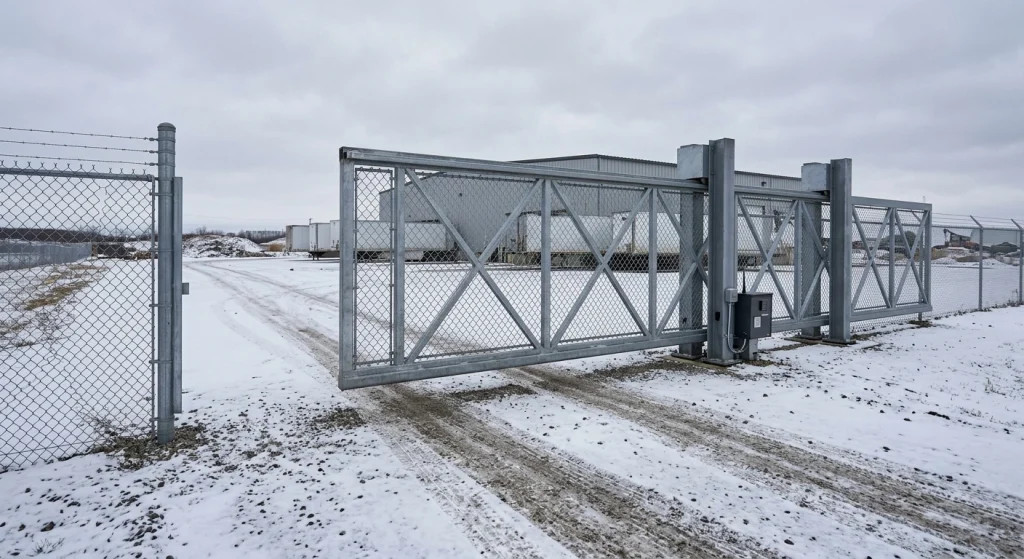
Cantilever gates are a different beast altogether. Instead of running along a ground track, the gate panel "floats" on rollers mounted to support posts. There is no track on the ground at all. This design was built for locations where the terrain is uneven or where snow and ice make a ground track impractical. They offer long-span capability for large openings and are highly durable in extreme weather.
You can explore Firm Fence's Cantilever Gates for industrial yards, transport depots, and utility facilities.
The Question Nobody Talks About: What Happens in a Canadian Winter?
Here is where the conversation gets interesting, because this is the part that most gate suppliers gloss over.
Canada is not a temperate country. We get snow. We get ice. We get freeze-thaw cycles that can wreak havoc on mechanical systems. And if you are operating a commercial or industrial site, a gate that freezes shut on a Monday morning is not just an inconvenience. It is a security risk and a logistical nightmare.
So how do these gate types hold up in our winters?
Swing Gates in Winter
Swing gates have a fundamental vulnerability in snowy conditions. The arc that the gate panel travels through when it opens or closes covers a large area. After a heavy snowfall, that arc fills with snow. When the automated operator tries to push the gate through that accumulated pile, it can encounter so much resistance that the operator's safety sensors interpret it as a foreign object. The system then kicks into safe mode and refuses to move. You are stuck shovelling or calling for service while delivery trucks back up at your entrance.
Sliding Gates in Winter
Sliding gates handle snow somewhat better because they move in a straight line rather than sweeping through an arc. They can cut through light accumulations with less effort. However, if you are running a track-mounted sliding gate, that ground track is exposed. It collects snow, ice, gravel, and debris. In freezing temperatures, moisture in the track can freeze solid overnight. You end up with a gate that will not budge until someone chips the ice out of the track or applies heat.
Cantilever Gates in Winter
This is exactly why cantilever gates have become so popular across Canadian industrial and commercial sites. With no ground track, there is nothing on the ground to freeze, fill with debris, or get blocked by snow. The gate floats above grade on its roller system, which means it operates smoothly even after the kind of overnight freeze that shuts down track-mounted systems. For sites in Ontario, Alberta, Quebec, or anywhere else that sees serious winter weather, this is not a small advantage. It is often the deciding factor.
Site Layout Considerations That Actually Matter
Beyond winter performance, your site layout will narrow down your options pretty quickly.
Space is the first thing to evaluate. Swing gates need clearance in front of and behind the opening equal to the width of the gate panel. If your gate opening is 20 feet wide, you need 20 feet of clear space for each panel to swing into. On a tight commercial lot or in a busy industrial yard, that space simply may not exist. Sliding and cantilever gates retract along the fence line instead, which means they only need lateral space beside the opening. Keep in mind, though, that cantilever gates need roughly 1.5 times the opening width in lateral space because of the counterbalance section of the gate.
Terrain is the second factor. If your driveway or entrance has a slope, a grade change, or uneven ground, a track-mounted sliding gate is going to cause problems. The track needs a level concrete grade beam to function properly. On an uneven surface, the gate can derail or bind. Cantilever gates avoid this issue entirely, and swing gates can work on mild slopes depending on the configuration.
Opening width matters too. For openings under about 14 feet, a single-leaf swing gate with one pad-mount operator is often the most cost-effective solution. Fewer components, simpler installation, and lower total cost. But for wider openings, particularly those in the 20 to 40 foot range that are common at trucking terminals and distribution centres, a sliding or cantilever system is almost always the better choice. For extra-wide openings, Firm Fence also offers Overhead Sliding Gates (Truss Gates), which use an overhead truss structure to prevent sagging and maintain alignment across long spans.
Traffic Volume and Frequency
How often your gate opens and closes in a day should weigh heavily in your decision.
Swing gates are perfectly fine for low to moderate traffic. Think of a secondary employee entrance, a service access point, or a parking lot that sees a few dozen vehicle entries per day. They open, they close, and they do not require a complicated mechanical system.
But if your site handles high-frequency traffic, such as a logistics hub where trucks are coming and going every few minutes, or a commercial parking facility with hundreds of daily entries, a sliding or cantilever gate with a high-cycle motor is the way to go. These gates are built for repetitive use, and their linear motion puts less stress on the operator over thousands of cycles.
For extremely high-traffic areas where you need quick, continuous flow, such as parking garages, hospital campuses, or LRT station access points, you might actually want to combine a gate system with Barrier Arms (Traffic Barriers). Barrier arms raise and lower rapidly and can integrate with RFID readers, keypads, and ticket dispensers. They are not perimeter security on their own, but paired with a proper gate system at the main entrance, they provide efficient traffic control at secondary access points.
Automation and Access Control
No matter which gate type you choose, automation is where the real value lies for commercial and industrial sites. An automated gate system eliminates the need for a person to manually open and close the gate every time a vehicle arrives. That saves labour, speeds up access, and tightens security.
Modern automated systems can integrate with remote controls, keypads, RFID readers, intercoms, security cameras, and smart controllers. Safety sensors prevent the gate from closing on a vehicle or person, and emergency release systems ensure the gate can be opened manually during a power outage.
One thing Canadian buyers should know is that automated gate systems installed in Canada now fall under the ANSI/CAN/UL 325 standard. This is the binational safety standard that was harmonized between Canada and the United States, and it is referenced in the Canadian Electrical Code. It sets out requirements for entrapment protection, safety sensors, and operator classifications. Any commercial or industrial gate automation should be installed in compliance with this standard. If your installer is not talking about UL 325 compliance, that is a red flag.
Firm Fence specializes in complete Automated Gate Systems that integrate with swing, sliding, or cantilever gates and meet the requirements for commercial and industrial applications.
What About Maintenance?
This is another topic that does not get enough honest discussion.
Swing gates generally have the lowest maintenance requirements. There are no wheels, no tracks, and no rollers to deal with. The hinges need periodic lubrication, and the operator needs seasonal attention, but the system itself is mechanically simple.
Sliding gates with ground tracks need more upkeep. The track has to be kept clean and clear of debris. In winter, you will need to manage ice buildup in the track. The rollers and wheels need inspection and lubrication, and in a high-cycle environment, these components wear out over time.
Cantilever gates fall somewhere in between. There is no ground track to maintain, which eliminates the biggest headache of a traditional slider. But the roller assembly and the counterbalance section do need periodic inspection. The good news is that for most commercial sites, this amounts to a couple of service visits per year.
Winter Maintenance Tip
One winter-specific tip that applies to all gate types: if your site is in a region where temperatures regularly drop below minus 20 Celsius, invest in a gate operator with a built-in heater or have a heater kit retrofitted. Cold temperatures thicken the oil in the operator's gearbox, which can slow the gate down or prevent it from operating altogether. Many commercial-grade operators now offer heater options rated for temperatures as low as minus 40.
Making the Final Call
There is no single "best" gate type. The right choice depends on your site's unique combination of space, terrain, traffic volume, weather exposure, and security requirements. Here is a quick way to think about it:
With more than 45 years of experience securing industrial yards, transit facilities, institutional campuses, and commercial properties, Firm Fence knows how to match the right gate to the right site. You can reach Firm Fence at 416-233-1811 or visit their website at firmfence.com to explore their full range of gates, automation systems, and perimeter security solutions.
Ready to Secure Your Site?
Get expert advice on choosing the right automated gate for your commercial or industrial property. Firm Fence has been Ontario's trusted partner since 1979.
Explore Gate Solutions