
How Much Does Commercial Fencing Cost in Ontario? A Budgeting Framework for Property Managers and GCs
Firm Fence · September 15, 2026 · 12 min read
Ask three contractors what a commercial fence costs and you'll get three numbers that don't match, and none of them are wrong. A chain link quote for a distribution centre in Brampton and a chain link quote for a school board site in Scarborough can land 40 percent apart even though both jobs use the same two words. Height, gauge, soil conditions, gate count, and this year's steel prices all move the number before a crew ever shows up on site.
So if you're budgeting a fencing project right now, whether you're a property manager building next year's capital plan or a GC pricing a tender, the useful question isn't "what does fencing cost." It's "what am I actually specifying, and what's driving the price of that spec." That's what this is for.
What actually moves the price
Per linear foot is the unit everyone quotes, and it hides more than it reveals.
Material and gauge
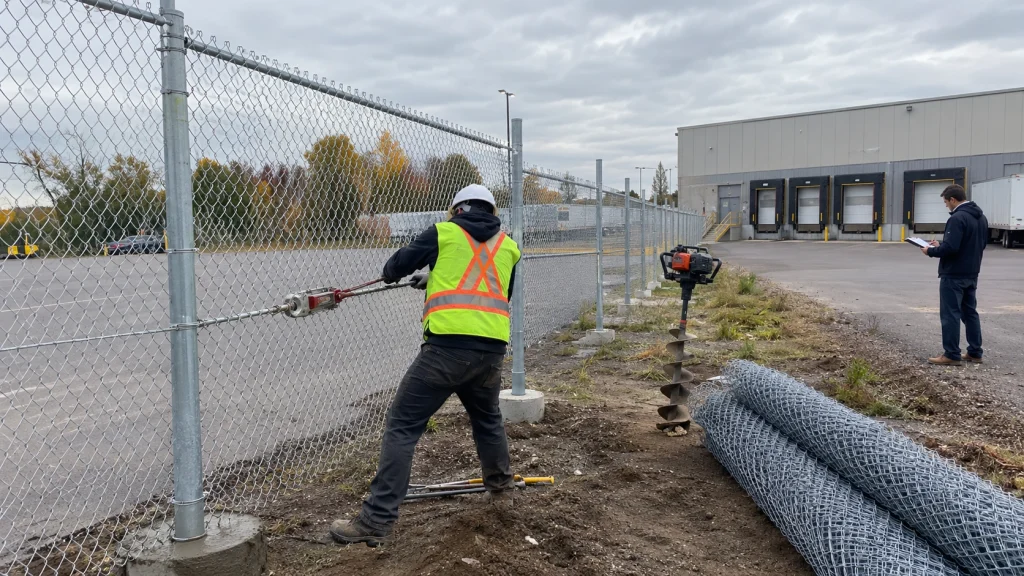
Galvanized chain link is still the default for industrial and utility sites because it's the cheapest way to get a compliant perimeter up fast. Heavier gauge wire, 6-gauge instead of the standard 9-gauge, costs more but resists cutting and holds up better to years of forklift traffic and snowplow contact along a yard fence line.
Height
Height isn't a proportional cost. Going from a 6-foot fence to a 10-foot fence needs bigger posts, deeper footings, and usually a heavier top rail, so the price curve bends upward faster than the extra four feet of fabric would suggest on its own.
Footing depth
Footing depth is the one that wrecks budgets built off a quick online calculator. Ontario's frost line sits roughly 4 feet down in the south and deeper, sometimes 5 to 6 feet, the further north you go. Footings that don't clear it will heave over a winter or two. A fence that looks fine in October and is leaning by March almost always has a footing problem, not a material problem.
Terrain
Terrain adds labour without adding much to the material list. Sloped or uneven ground needs racking and stepping to follow grade, and that's crew time, not fabric.
Gates and access control
Gates and access control deserve their own section, because they're the single biggest source of tender surprises. So do permits and locates, because almost nobody outside the trade thinks about them until the project stalls.
The market itself
And then there's the market itself. Steel and aluminum have been the standout cost pressure in Canadian construction pricing through 2026, tied directly to cross-border tariffs on both metals. If your last fencing quote is more than a year old, don't be surprised if the new one runs noticeably higher. Once you accept a quote, get a written price-hold period, and ask how long the number is actually good for.
What commercial fencing actually costs in Ontario right now
All figures below are Canadian dollars, installed, for a straightforward run with reasonable access and no major site complications. Treat these as planning ranges, not quotes. A site walk beats a spreadsheet every time.
Galvanized chain link
6 to 8 feet, 9-gauge: roughly $25 to $50 per linear foot. This is still the workhorse for warehouses, storage yards, schools, and construction perimeters, and it's what most industrial and institutional clients across the GTA end up specifying for straightforward perimeter security. Vinyl-coated finishes in black, green, or brown typically add $3 to $6 per foot over bare galvanized, mostly for sites where a silver mesh fence doesn't match the brand.
High-security chain link
10 to 12 feet, 6-gauge, with barbed wire or razor ribbon top guard: often $55 to $90-plus per linear foot once you account for the heavier mesh, taller posts, deeper footings, and top-guard hardware. This tier shows up around airports, transit corridors, utility substations, and restricted-access sites.
Ornamental steel or aluminum
Powder-coated, open picket style: roughly $45 to $95 per linear foot for standard commercial and institutional specifications, climbing well past that for tall, fully private, or heavily customized profiles. This is what you spec when the property fronts a public street or the ownership group wants security without looking like a compound. It shows up on corporate plazas, multi-residential developments, and municipal buildings.
Welded wire mesh panels
Priced above standard chain link and can run close to or past ornamental pricing, since the rigid, welded anti-climb panel construction costs more to fabricate than woven mesh. Common around data centres, substations, and sites where the fence is part of the security system, not just a boundary line.
Temporary and construction fencing
Priced as a rental, not a purchase, quoted as a rate per linear foot per week or month, plus separate delivery, setup, and teardown charges that apply no matter the job size. If you're a GC running site security across several projects a year, run the math on buying panels outright. Past a certain point, cumulative rental costs beat owning the stock.
High-security and crash-rated systems
Reinforced posts, welded steel panels, and gate hardware built to withstand vehicle impact, typically specified to meet ASTM crash-rating standards. Pricing here is genuinely project-specific, driven by the rating required, so a ballpark number isn't worth much. Budget for an engineering consultation as part of the design, not an afterthought.
Gates: the line item that blows up commercial budgets
Property managers and GCs consistently underprice gates relative to fence, and it's the most common source of tender shock we see. A single automated slide or cantilever gate, including operator and basic access control (keypad or remote), typically runs $8,000 to $25,000 installed in Ontario, depending on opening width and site conditions. Double gates, heavy-duty industrial operators, or a full access control build-out (card readers, loop detectors, intercom tied into a building management system) can push that into $30,000 to $60,000-plus.
Cantilever gates skip the ground track, which matters a lot here, since a buried or iced-over track is a maintenance headache every single winter. If your fence line has room for the cantilever counterbalance tail (usually 30 to 50 percent of the gate opening), it's almost always the better spec for Ontario conditions than a tracked slider.
For the spec sheet: standards and code basics
Chain link fabric galvanizing is governed by ASTM A392, which sets mesh size, wire gauge, fabric height, and zinc coating class. Fabricated steel components, posts, frames, gate hardware, are typically specified to ASTM A123 for hot-dip galvanized coatings, a separate standard from the fabric itself. If a supplier can't tell you which standard their galvanizing meets, ask before signing off on materials.
Footing depth is a frost issue, not a preference. The Ontario Building Code requires footings below the local frost line, generally landing around 4 feet in southern Ontario and deeper as you move north. Confirm the exact number with the local building department rather than assuming one province-wide figure.
Height limits are municipal, not provincial, and often differ for residential versus non-residential properties under the same by-law. Toronto's fence by-law (Municipal Code Chapter 447), for example, sets different maximum heights depending on whether a property is residential or non-residential and where the fence sits on the lot. A number that's compliant in one city isn't automatically compliant in the next.
Locates aren't optional. Under Ontario's Underground Infrastructure Notification System Act, anyone digging or driving posts, homeowner or GC, has to request a locate through Ontario One Call at least five business days ahead. It's free. Skipping it on a commercial site with services nearby is how a fencing job turns into an insurance claim.
A simple framework for budgeting your project
Once you know your fence type and rough linear footage, build the number like this:
That contingency line isn't padding. It's the difference between a budget that survives contact with the ground and one that doesn't.
Questions Ontario property owners actually ask, that most guides skip
Do I need a permit for commercial fencing in Ontario?
Usually, and it depends on your municipality, not the province. Height, location on the lot, and whether the property is zoned residential or non-residential all factor in. Confirm with your local building or zoning department before the design is finalized, not after it's priced.
Who's responsible for a fence sitting on the line between two commercial properties?
Ontario's Line Fences Act sets up a dispute resolution process, using municipally appointed fence-viewers, for shared boundary fences. But most urban municipalities, Toronto included, have their own fence by-law that takes precedence over the Act in most situations. Neither one tells you where your property line actually sits. That's a survey question, and it's worth settling before a disagreement with the neighbouring owner, not during one.
Can fencing actually be installed during an Ontario winter?
Yes, but budget for it differently. Frozen ground usually needs mechanical augering or hoe-ramming instead of a hand auger, concrete cure times stretch out in the cold, and a contractor worth hiring plans around both instead of pretending winter is the same as September. If a quote doesn't mention how they'll handle a frozen site, ask.
Why did my fencing quote come in higher than last year's?
Steel and aluminum. Both have been under sustained price pressure in the Canadian market through 2026 due to cross-border tariffs, and that flows straight into chain link, ornamental, and gate hardware pricing. It's not your contractor padding the number. Ask for a written price-hold period once you accept a quote, since material costs can move again before installation.
Chain link or ornamental for a multi-tenant industrial park?
Chain link if security and budget are the priority, which covers most industrial park perimeters. Ornamental steel or aluminum if the property fronts a public road, the ownership group cares how the asset presents to tenants and passersby, or lease terms specify a certain standard of finish. Plenty of sites use both: chain link around the yard and loading areas, ornamental along the street frontage.
Where to start
Every range above assumes a straightforward site. Yours might not be. The only way to get a number you can actually build a budget or a tender around is a site assessment from a contractor who's done enough Ontario commercial work to know what your specific ground, grade, and access will require.
Firm Fence has been doing exactly that across the GTA and Southwestern Ontario since 1979, and offers free, no-obligation site assessments for commercial and industrial projects (firmfence.com/contact-us). If you're at the stage of pricing a capital project or a tender, that's the call to make before the number gets locked into a budget.
Ready to price your project?
Get a free, no-obligation site assessment from a team that's been installing commercial fencing across the GTA and Southwestern Ontario since 1979.
Book a Site Assessment