
Why Every Commercial Fence Project Starts With a Utility Locate (and What Happens If You Skip It)
Ask any commercial fence installer in the GTA what causes the worst preventable delays and cost overruns, and the answer is almost never the fence itself. It is the ground underneath it.
A single post hole in the wrong spot can hit a Bell fibre run, an Enbridge gas service, or a private irrigation main that nobody knew existed. That one strike can turn a routine three-day install into a six-figure liability event complete with utility crews, safety inspectors, and a phone call to your insurance broker that nobody wants to make.
This is why every serious commercial fence project in Ontario starts the same way. A locate request goes in before anything else moves.
What a Locate Actually Is
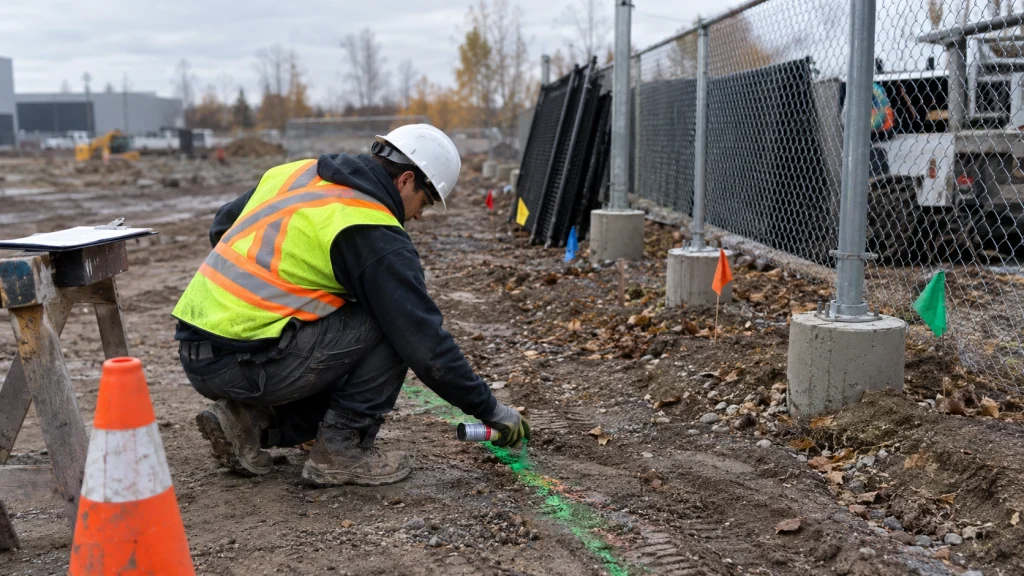
In Ontario, the legal starting point is Ontario One Call. Under the Ontario Underground Infrastructure Notification System Act, 2012, anyone breaking ground has to submit a locate request before excavation begins. Requests go through the OOC web portal or by calling 1-800-400-2255. Ontario One Call then notifies every registered member utility that owns buried infrastructure in that area. Those utility owners, or the locate service providers they contract, come out and paint the ground using the APWA colour code (red for electric, yellow for gas or oil, orange for communications, blue for potable water, green for sewer).
Standard locate requests must be completed within 5 business days. Advanced or large excavation projects covering multiple properties, or sites with no civic address, get 10 business days. Locates are valid for a minimum of 60 calendar days from issue. Starting November 1, 2026, a new regulation lets eligible dig sites continue for up to 180 total days without a relocate, provided the site meets specific conditions (no transmission infrastructure present, digging happens at least 1 metre below the lowest identified utility, and self-attestation and documentation requirements are met).
Other provinces have their equivalents. BC 1 Call, Alberta One-Call, Info-Excavation in Quebec, Sask 1st Call. The rules vary. The principle does not. You do not put a shovel or an auger in the ground until you know what is under it.
Why Fence Projects Are Higher Risk Than People Assume
Most people think fence installs are low risk because posts do not go that deep. That assumption is wrong for Canadian commercial work.
Chain link and ornamental steel systems designed for Ontario winters need footings set below the frost line, which typically means 4 to 5 feet of concrete-set post depth to prevent heave. A 6 or 8 inch auger going down 48 inches will absolutely reach primary gas mains, secondary electric feeds, communication conduits, and water services. It will also reach the private lines that nobody put on a public utility map.
That last part is where most projects run into trouble.
Public vs Private Locates: The Gap Nobody Explains
Ontario One Call locates public utility infrastructure only. That means mains and service lines up to a specific demarcation point, usually the property line or the utility meter. Anything downstream is the property owner's responsibility, and OOC will tell you exactly that in the locate package.
On a commercial site, private infrastructure typically includes:
- Private electrical feeds to yard lighting, security systems, gate operators, and detached buildings
- Private gas lines running from the meter to generators, patio heaters, or process equipment
- Irrigation lines and low-voltage landscape lighting
- Fibre-optic runs between buildings on a shared campus
- Site drainage, septic components, and stormwater management piping
- Private water lines feeding hose bibs, fountains, or outbuildings
None of this appears on an Ontario One Call locate. To identify these lines you need to hire a private locate contractor who uses ground penetrating radar and electromagnetic locators. On any commercial site with detached structures, security lighting, or irrigation, this is not optional. It is the second half of due diligence.
I have seen a crew show up with a One Call ticket in hand, drill through a private fibre run linking two buildings on a corporate campus, and take down that tenant's operations for a full business day. The public locate ticket was legally sufficient. The install was still a disaster.
What Actually Happens If You Skip the Locate
The numbers here get uncomfortable. According to the Canadian Common Ground Alliance's DIRT reporting, damage to buried utilities costs the Canadian economy in excess of $1 billion every year. Historical DIRT data shows roughly 1 in 4 damage events happen because no locate request was made at all, and nearly 1 in 5 involve life-threatening facilities like gas mains or high-voltage electric.
For a commercial contractor, the fallout of a strike breaks into four categories.
Repair cost
Utilities charge the excavator for the repair. Estimate only, based on industry norms: gas main strikes in the GTA commonly run in the low five figures for a straightforward repair, and considerably more if service is interrupted or the strike causes secondary damage. A hit to a fibre backbone can invoice into six figures once the carrier tallies service credits to affected customers.
Regulatory penalties
Ontario One Call, the Ministry of Labour, and the Technical Standards and Safety Authority (TSSA) can each issue administrative penalties. Section 228 of Ontario Regulation 213/91 (Construction Projects) requires contractors to have all underground utilities located and marked before digging. Violations are enforceable against both the constructor and the individual worker on the tool.
Site shutdown
When a utility gets hit, work stops. The area is cordoned off, emergency crews take over, and the fence crew stands around on the clock until the utility owner clears the site. On a large commercial job that can burn a full day of billable labour and push the schedule back a week.
Liability exposure
If a strike causes personal injury, service disruption to a hospital or emergency service, or environmental release, the contractor's insurance carrier becomes very interested very quickly. Many commercial general liability policies exclude damages arising from failure to comply with call-before-you-dig requirements. That means the loss lands on the contractor personally.
Questions Canadian Property Owners Should Be Asking (But Rarely Do)
A few things that come up on almost every commercial call, and that most contractors never explain clearly:
Do I need a locate for a residential backyard fence?
Yes. Ontario One Call rules apply to homeowners and contractors equally, on both public and private property. Free to request, mandatory by law.
Is the locate valid forever?
No. Minimum 60 days. If your project keeps getting delayed by weather or material shortages, you may need a relocate. Track the expiry date.
Who pays for private locates?
The property owner or the contractor, depending on how the contract is written. It is not free like the One Call request. Expect a few hundred to a couple of thousand dollars for a typical commercial site (estimate only, depends on square footage, method used, and complexity).
Does the fence contractor handle all of this?
A good one does. A cheap one hands you the ticket number and tells you to sort it out. Ask up front, in writing.
What about winter installs?
Locates are still valid in winter, but frost cover and snow make paint marks hard to see. Experienced Canadian crews use secondary reference measurements offset from permanent features so markings are not lost when the snow flies.
How This Shows Up on the Actual Build
Once locates come back and both public and private infrastructure is identified, the design gets adjusted. Post locations shift. Sometimes a run has to be offset to avoid a shallow gas service. Sometimes a bollard cluster gets added to protect a gate operator instead of drilling deep footings next to a fibre trench. This is where an experienced commercial contractor earns their fee.
At Firm Fence, this is built into how the crews scope every commercial and industrial project. The company has installed perimeter security fencing across Etobicoke, the GTA, and Ontario for more than 45 years, and the product mix reflects what real Canadian sites actually need:
Commercial chain link systems

Galvanized, vinyl-coated black, or PVC-clad, for warehouses, distribution yards, self-storage sites, and industrial perimeters where economy and durability matter. Product reference: https://www.firmfence.com/commercialindustrial-fencing
Ornamental steel and wrought iron

Powder-coated pickets for institutional properties, schools, and higher-visibility commercial sites where perimeter security has to coexist with the architecture. Product reference: https://www.firmfence.com/commercialindustrial-fencing
Swing and sliding gates with access control integration

Cantilever sliders for wide industrial openings and swing gates for controlled pedestrian and vehicle entry, typically tied into keypad, card reader, or intercom systems.
Every one of these product categories has post or footing requirements deep enough to matter for a locate.
The Bottom Line
Utility locates are the cheapest and most valuable piece of risk management on a commercial fence project. The request is free. The wait is 5 business days. The regulation is not new, it is not going anywhere, and enforcement is real. Skipping it to save a week is the kind of shortcut that ends careers, not just projects.
If you are an architect specifying a perimeter security package, build the locate step into your Division 32 fencing specifications and reference the Ontario One Call requirement in the general conditions. If you are a general contractor, do not accept a fence sub who cannot produce a locate ticket before mobilization. If you are a commercial property owner in Ontario, ask your installer two questions before you sign. First, are they submitting the One Call request or are they expecting you to. Second, have they engaged a private locate service for on-property infrastructure. If the answers are vague, keep interviewing.
Ready to Start Your Commercial Fence Project?
For a walkthrough of a commercial site with locate coordination built into the scope, visit https://www.firmfence.com/ or contact the Firm Fence team directly.
Contact Us