
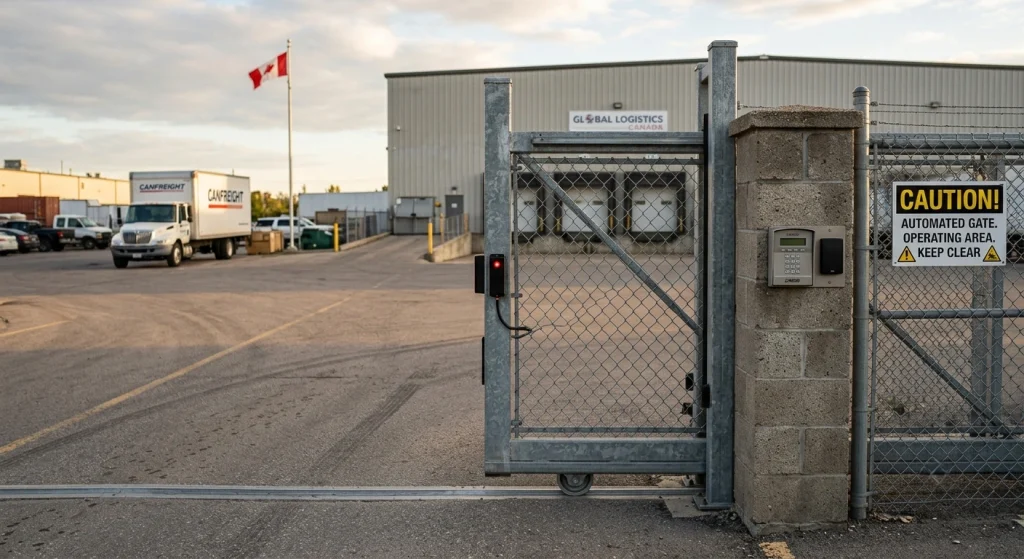
UL 325 Explained: The Safety Standard Behind Every Commercial Automated Gate, a Real Compliance Question Almost Nobody Local Explains Clearly
If you manage a commercial property in Ontario, or anywhere in Canada for that matter, you have probably dealt with the headache of getting an automated gate installed. Maybe it was for your warehouse yard, a hospital parking structure, or an LRT maintenance facility. And somewhere in that process, your installer or a spec sheet threw around the term "UL 325." You nodded. You moved on. And nobody really stopped to explain what it actually means for your site, your liability, or your people.
That is the problem. UL 325 is one of the most important safety standards in the automated gate industry, and yet most property owners, facility managers, and even some general contractors across Canada have never had someone sit down and walk them through it in plain language. This article is going to change that.
Let us start from the beginning.
What Exactly Is UL 325?
UL 325 stands for Underwriters Laboratories Standard 325. Its full title is "Standard for Safety: Door, Drapery, Gate, Louver, and Window Operators and Systems." That is a mouthful, but the part that matters to you is the gate operator portion.
In simple terms, UL 325 lays out the minimum safety requirements that manufacturers and installers must follow when building and installing automated gate systems. It covers the operator (the motor and control unit that moves the gate), the entrapment protection devices (the sensors and edges that stop the gate from crushing something or someone), and the overall installation.
This standard was developed by Underwriters Laboratories in collaboration with industry manufacturers. Its primary purpose is preventing entrapment injuries and deaths caused by automated gates. These are not hypothetical risks. Automated vehicular gates generate enormous force. A heavy sliding gate or a large cantilever gate can weigh hundreds of pounds, and when that kind of mass is in motion, even at modest speeds, it can cause devastating injuries if someone gets caught in its path.
Why Should Canadian Property Owners Pay Attention?
Here is where it gets interesting for anyone operating north of the border. For years, Canada had its own separate standard for gate operators under CSA C22.2 No. 247. The United States followed UL 325. The two countries had similar requirements but separate paperwork.
That changed. The safety requirements for both countries have been combined into a single binational standard called ANSI/CAN/UL 325. It was approved as a National Standard of Canada by the Standards Council of Canada (SCC), and it is now referenced in the Canadian Electrical Code (CSA C22.1). So if you are installing or upgrading an automated gate in Canada today, this is the standard your system needs to meet.
Most local fence and gate companies in Ontario will tell you they follow the code. But very few actually walk their clients through what compliance looks like on a practical level. That matters, because as the property owner, you carry the liability.
The Four Classes You Need to Know
One of the most significant changes introduced in the 7th Edition of UL 325 was the formal classification of gate operators into four categories based on where and how they are used. Understanding which class your site falls into is step one.
Class I
Class I is for residential applications, specifically garages or parking areas associated with one to four single-family homes. If you are reading this blog, your site probably does not fall here.
Class II
Class II covers commercial and general access locations. Think multi-family residential buildings with five or more units, hotels, retail plazas, office complexes, hospitals, and any property where the general public may be passing through. This is the classification that applies to most commercial properties across the GTA and Ontario.
Class III
Class III is for industrial and limited-access locations. This includes factories, loading docks, logistics hubs, and other sites that are not open to or intended for use by the general public. If you run an industrial yard with controlled access, this is likely your class.
Class IV
Class IV applies to restricted-access environments like airports, correctional facilities, military installations, and other high-security zones where access is supervised by security personnel at all times.
Each class carries specific requirements for the types and number of entrapment protection devices your gate system needs. Misclassifying your site, say, treating a Class II location like a Class I, is one of the most common compliance gaps in the industry, and it can leave you wide open to liability if an incident occurs.
What Are Entrapment Protection Devices?
This is another area where the standard gets practical. UL 325 requires at least two independent entrapment protection devices for each potential entrapment zone, in each direction the gate travels. That is not optional. If those devices are not installed and functioning, compliant gate operators are designed not to run at all.
The standard defines several types of entrapment protection:
Type A
Type A is the inherent entrapment protection system built into the gate operator itself. This typically involves motor force sensing that detects resistance when the gate hits an obstruction.
Type B1
Type B1 refers to non-contact sensors, most commonly photoelectric eyes. These project an invisible beam across the gate opening. When a person, vehicle, or object breaks that beam while the gate is moving, the system stops and reverses.
Type B2
Type B2 covers contact sensors, also called edge devices. These are pressure-sensitive strips mounted on the leading edge of the gate panel. If the gate makes physical contact with something, the edge compresses and triggers the system to stop.
Type C
Type C includes inherent force-limiting devices, adjustable clutches, or pressure relief mechanisms.
Type D
Type D is a dead-man control, a device that requires constant pressure to keep the gate moving. Release the button, and the gate stops.
Not every type is allowed for every class or every gate style. For example, a Type C device can be used on a swing gate or barrier arm, but it is not permitted on a slide gate or vertical lift gate. These details matter, and they are exactly the kind of thing that gets overlooked when installers cut corners.
For sites that need reliable automated gate systems with integrated safety sensors and emergency release features, Firm Fence offers complete automation setups compatible with swing, sliding, and cantilever gate types.

How UL 325 Works Together with ASTM F2200
You cannot talk about UL 325 in isolation. It works hand in hand with another standard called ASTM F2200, which focuses specifically on the construction of the gate panel itself rather than the operator.
While UL 325 governs the operator, the sensors, and the installation requirements, ASTM F2200 sets out how the physical gate should be built to minimize entrapment hazards. This includes things like screening openings on horizontal slide gates from the bottom of the gate to at least 4 feet above the ground, so that a 2.25-inch diameter object (roughly the size of a small child's arm) cannot pass through.
Together, these two standards form a complete safety framework. A gate system that meets UL 325 but ignores ASTM F2200 is only half compliant. And a beautifully constructed gate panel without proper operator safety is equally dangerous.
Another important requirement: UL 325 mandates a separate pedestrian entrance gate located outside the path of the automated vehicular gate. Pedestrians should never be expected to walk through an automated vehicle gate opening. This is a rule that gets violated surprisingly often at commercial sites, particularly at older properties that were retrofitted with automation after the original manual gate was installed.
Real Questions Canadian Property Managers Ask (That Nobody Answers)
After years in this industry, here are some of the questions we hear most often from Canadian commercial clients. These rarely get addressed by local installers, and almost never show up in the glossy brochures.
"Does UL 325 actually apply to us in Canada, or is it just an American thing?"
Yes, it applies. As mentioned above, ANSI/CAN/UL 325 is now a binational standard recognized by the Standards Council of Canada. If your gate operator does not carry a valid listing mark from a Nationally Recognized Testing Laboratory (NRTL) like UL or ETL, it does not meet the standard.
"Can I just install a gate without sensors to keep things simple?"
No. If you install a UL 325-listed gate operator without the required external entrapment protection devices, the operator is designed to refuse to run. And if someone bypasses that monitoring, they are violating the standard and taking on massive personal and corporate liability.
"Who is responsible if someone gets hurt, the installer or the property owner?"
Both, potentially. The installer has a responsibility to follow the manufacturer's instructions and the applicable standards. But the property owner has a duty to ensure the system is maintained and continues to operate safely. Insurance companies in Canada increasingly require documented UL 325 compliance for automated gate systems, and a non-compliant installation could result in a denied claim.
"What about our Canadian winters? Do sensors even work in the snow?"
This is a legitimate concern, and it is one reason why gate type selection matters so much in this country. Cantilever gates, for instance, are specifically designed for sites where snow accumulation and uneven terrain make ground-track sliding gates impractical. And modern photoelectric sensors are built to handle harsh weather, though they do need regular cleaning and maintenance during winter months.


Additional Installation Rules That Often Get Missed
There are a few other provisions in UL 325 that even experienced contractors sometimes overlook.
Gate operator controls must be located at least 7 feet away from the gate itself, so the person operating the controls cannot physically reach the gate while it is moving. Any control used to reset the operator after two consecutive activations of an entrapment device must be positioned within direct line of sight of the gate.
Warning signs are required on both sides of the gate, clearly visible to anyone approaching the gate area. This sounds basic, but you would be surprised how many commercial installations across Ontario are missing signage entirely.
Class I and Class II slide gate operators are not allowed to exceed a travel speed of 1 foot per second when pulling 75 pounds or more. Speed matters because a faster gate carries more kinetic energy and is more dangerous in an entrapment scenario.
And here is one that catches a lot of people off guard: manufacturers are prohibited from providing resistors with their operators or instructions for bypassing, reprogramming, or resetting monitored safety outputs in any way that does not comply with the standard. If anyone suggests a workaround to disable your safety monitoring, walk away.
Choosing the Right Gate for Your Application
Understanding UL 325 is not just about checking a compliance box. It should actually influence the type of gate you choose for your property.
For commercial parking lots and institutional entrances, Swing Gates offer a traditional, reliable solution that works well with automation and access control integration.

For high-traffic commercial areas like parking structures and toll booths, Barrier Arms (Traffic Barriers) provide fast operation and integrate easily with RFID readers, keypads, and ticket dispensers.

For trucking terminals, distribution centres, and secured industrial zones that need wide openings, Overhead Sliding Gates (Truss Gates) provide the structural strength and long-span capability required for heavy-duty applications.

And for airports, government buildings, data centres, and other high-security facilities operating under Class IV requirements, Crash-Rated Barriers provide engineered and certified crash ratings (K4 through K12 / M30 through M50) to protect against forced vehicle entry.

The Bottom Line
UL 325 is not just a sticker on a piece of equipment. It is a safety framework that protects the people who walk and drive through your gate every single day. It protects your employees, your visitors, your tenants, and it protects you from the kind of liability that can shut a business down.
If you are planning a new automated gate installation, upgrading an older system, or simply unsure whether your current setup is compliant, the time to ask questions is now, not after an incident.
Firm Fence has been providing commercial fencing and gate solutions across Ontario since 1979. Our team understands UL 325 and ASTM F2200 inside and out, and we design every automated gate installation to meet or exceed the current binational safety standards. Whether your project is a warehouse yard in Mississauga, an LRT station in Toronto, or a hospital campus in Ottawa, we have the experience and the product range to get it done right.
Ready to Make Your Gate Compliant?
Get in touch for a free consultation and site evaluation. Our team will walk you through exactly what your property needs to meet UL 325 and keep your people safe.
Contact Us