
Barrier Arms vs. Full Automated Gates: Right-Sizing Vehicle Access Control
If you manage a commercial property, a hospital parking structure, an industrial yard, or a transit facility somewhere in Canada, you have probably asked yourself a version of this question at some point: do I need a barrier arm, or should I go with a full automated gate?
It sounds simple enough. But the answer depends on a lot more than most people realize. Traffic volume, site layout, security requirements, Canadian weather, budget, and even the type of vehicles entering your property all play a role in the decision. And the cost of getting it wrong is not just financial. A mismatched access control system creates bottlenecks, frustrates drivers, weakens your security posture, and can even put people at risk.
Let us walk through the real differences between barrier arms and full automated gates so you can make a decision that actually fits your site.
What Exactly Is a Barrier Arm?
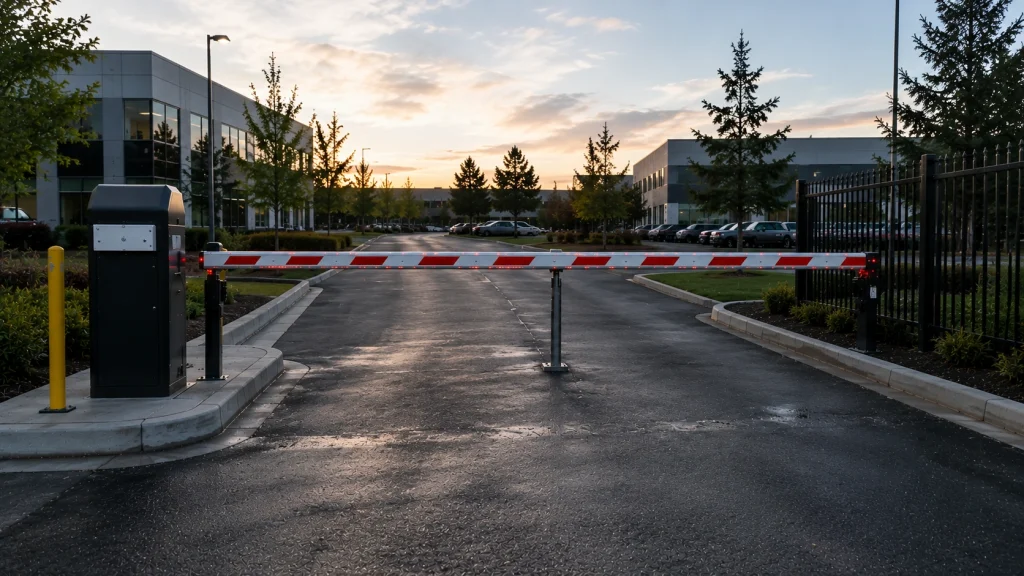
A barrier arm (sometimes called a boom gate) is a motorized horizontal bar that raises and lowers to let vehicles through one at a time. You see them everywhere: parking garages, toll booths, hospital entrances, airport short-term lots, and commercial building lobbies.
They are designed for one thing above all else: controlling the flow of traffic. A barrier arm opens fast, closes fast, and can process a high volume of vehicles per hour without creating long lineups. Most modern barrier arms integrate with RFID readers, keypads, license plate recognition cameras, and ticket dispensers, so you can automate the entire entry and exit process without stationing a guard at the booth around the clock.
That said, a barrier arm is not a physical security barrier in the traditional sense. It will not stop a vehicle that is determined to push through. The arm itself is typically a lightweight aluminum or fiberglass bar, often designed to break away on impact so it does not damage the vehicle or the operator mechanism. The idea is deterrence and traffic management, not anti-ram protection.
Product Reference: Firm Fence offers Barrier Arms (Traffic Barriers) built for commercial and high-traffic environments with options for standard, heavy-duty, and crash-rated configurations, complete with LED lights and reflective strips for visibility.

What Counts as a Full Automated Gate?
When people say "full automated gate," they usually mean a sliding gate, a cantilever gate, a swing gate, or an overhead truss gate that is motorized and controlled through some form of access system. Unlike a barrier arm, a full gate creates a continuous physical barrier across the opening. Nothing gets through unless the gate opens.
Automated gates are built from heavy-duty steel and are designed to handle large openings, sometimes spanning 20 to 40 feet or more. They are commonly found at industrial warehouses, logistics centres, trucking terminals, corporate campuses, utility substations, and high-security government facilities.
The key difference is simple: a full automated gate provides both access control and perimeter security. A barrier arm provides access control only.
Product Reference: Firm Fence provides complete Automated Gate Systems with remote, keypad, or RFID access control, safety sensors, emergency release, and heavy-duty motors built for high-cycle commercial use.

So How Do You Decide? Start With These Five Questions.
What is your actual security requirement?
This is the first question that matters, and it is the one that most people skip over too quickly. There is a big difference between "we need to manage who comes in and out" and "we need to physically prevent unauthorized vehicles from entering the property."
A barrier arm is perfect when your goal is traffic management and basic access control. Think parking lots at hospitals, commercial office buildings, or airport economy lots. Drivers stop, scan a card or take a ticket, and the arm lifts. It keeps things organized and prevents random vehicles from wandering in.
But if you are running a data centre, a water treatment plant, a secured transit depot, or a defence facility, a barrier arm alone is not going to cut it. You need a physical barrier that cannot be driven through. That is where a full automated gate comes in.
For sites that need the highest level of protection against vehicle ramming, Firm Fence offers Crash-Rated Barriers certified to ASTM and DoD impact standards (K4 through K12 / M30 through M50), available as bollards, wedge barriers, or beam gates.

How much traffic does your site handle daily?
This is where barrier arms really shine. If your site processes hundreds or even thousands of vehicles per day, a barrier arm is hard to beat. The arm raises in about one to three seconds, the vehicle passes through, and the arm drops back down. That kind of cycle speed is critical during peak hours at places like hospital emergency departments, airport pick-up zones, or busy commercial parking lots.
A full automated gate, on the other hand, takes longer to open and close. A sliding gate might take 15 to 30 seconds to fully open depending on the span, and then the same amount of time to close. That is fine if you are processing 50 to 100 vehicles per day at a warehouse or an industrial yard. But if you try to run a 500-car-per-hour parking operation through a 30-foot sliding gate, you are going to have a lineup stretching around the block by lunchtime.
The takeaway: high-volume, lower-security applications generally favour barrier arms. Lower-volume, higher-security applications favour full gates.
What does the Canadian climate do to your access point?
This is the question that almost nobody talks about in the sales brochures, but it matters enormously if you are operating in Ontario, Alberta, Manitoba, or anywhere else in Canada where winter actually happens.
Barrier arms are relatively unaffected by snow and ice. The mechanism is compact and mounted above ground. As long as the motor housing stays clear and you keep the pivot point lubricated, a barrier arm will operate reliably through a Canadian winter. Some operators add heating elements to the motor housing as an extra precaution, but generally these systems handle cold weather without major issues.
Full automated gates are a different story. Sliding gates that run on a ground track can become a serious headache in winter. Snow packs into the track. Ice freezes in the V-groove. Road salt corrodes the wheels and rollers. If a chunk of ice locks up the track on a Monday morning in February, that gate is not opening until someone gets out there with a shovel and a torch.
This is exactly why cantilever gates have become so popular for Canadian industrial and commercial sites. A cantilever gate floats on rollers mounted to support posts, so the gate panel never touches the ground. No ground track means no ice buildup, no snow jamming, and no frozen channel to deal with after a blizzard. Firm Fence builds Cantilever Gates specifically for uneven terrain and heavy snow accumulation, and they pair beautifully with automation systems.

For sites where lateral space is limited but you still need a rugged, weather-resistant sliding option, Firm Fence also offers Sliding Gates with track-mounted or cantilever designs in heavy-duty steel construction.

How much space do you actually have?
Space constraints are another factor that tends to get overlooked until installation day, and by then it is an expensive problem to fix.
Barrier arms have a tiny footprint. The operator unit is compact, and the arm swings up vertically, so you do not need any lateral clearance. They fit into tight parking garage entrances, narrow laneways, and cramped toll booth setups without any issues.
Full gates need room to move. A sliding gate needs enough fence line on one side to store the entire gate panel when it is open. A cantilever gate needs about 50% more space than the opening itself because of the counterbalance section. For a 20-foot opening, you would need roughly 30 feet of clear space on one side for a cantilever gate to fully retract.
Swing gates need clearance in front of or behind the gate panel to swing open, which can be a problem in areas with vehicle queuing. And for the widest industrial openings (20 to 40+ feet), Overhead Sliding Gates (Truss Gates) from Firm Fence offer a solution that handles massive spans without sagging or ground-track maintenance issues.

What is your budget, and what is the total cost of ownership?
Upfront cost is important, but it should not be the only number you look at. A barrier arm is almost always less expensive to purchase and install than a full automated gate. That makes it tempting if you are watching the budget.
But you also need to think about maintenance, lifespan, and what happens when something goes wrong. A well-maintained barrier arm can run reliably for 10 to 15 years. A well-maintained automated gate can last 20 to 25 years. Track-mounted sliding gates require regular track cleaning, especially in Canadian winters, and that ongoing maintenance cost adds up over the years. Cantilever gates, with no ground track to maintain, tend to have lower lifetime maintenance costs even though the initial investment is higher.
And then there is the cost of downtime. If your gate fails at a busy hospital or transit depot, the operational disruption can cost far more than the repair itself. Choosing the right system from the start, even if it costs a bit more upfront, saves you headaches and money in the long run.
Common Questions Canadian Buyers Ask (That Nobody Seems to Answer)
Do I need a permit to install an automated gate or barrier arm in Ontario?
Yes, in most municipalities across Ontario and other Canadian provinces, you need a building permit and possibly an electrical permit for motorized gate installations. Some cities also have bylaw requirements around gate setback distances, height restrictions, and safety features like photo-eye sensors and emergency manual release mechanisms. Always check with your local municipality before starting installation.
Can I combine a barrier arm and a full gate on the same site?
Absolutely, and this is actually one of the smartest configurations for sites that have different security zones. You might use a barrier arm at the main parking entrance where traffic volume is high and the security requirement is moderate, and then use a full automated sliding or cantilever gate at the entrance to a restricted zone within the same property. Logistics depots, hospitals, and airport facilities commonly use this kind of layered approach.
What about pedestrian safety around automated gates?
This is a critical concern, especially at sites where foot traffic crosses vehicle entry points. Both barrier arms and full automated gates should be equipped with safety sensors, including photo-eye beams, loop detectors, and anti-crush mechanisms. In Canada, CSA standards apply to automated gate installations, and these standards require specific safety features to protect both pedestrians and vehicle occupants.
How does road salt affect gate and barrier hardware?
Salt spray and road salt runoff are brutal on metal components, and this is something that does not get nearly enough attention in the access control conversation. Standard zinc-plated hardware can fail within four to six years in salt-heavy Canadian conditions. Hot-dip galvanized or stainless steel fasteners, rollers, and tracks are the right choice if you want your system to last. Firm Fence uses industrial-grade, corrosion-resistant materials across their product lines, which is especially important for sites near highways, airport runways, and urban streets where salt use is heavy.
The Bottom Line
There is no universal right answer to the barrier arm vs. full automated gate question. The right system depends on your specific combination of traffic volume, security needs, climate exposure, available space, and budget.
If you need high-speed traffic management with moderate access control, a barrier arm is likely your best bet. If you need serious perimeter security with physical vehicle denial, a full automated gate is the way to go. And if your site has multiple zones with different requirements, a combination of both might be exactly what you need.
Need Help Choosing the Right System?
Firm Fence has been helping Canadian commercial and industrial clients navigate these decisions since 1979. Based in Toronto and serving all of Ontario, they specialize in designing access control solutions that are tailored to the actual conditions on your site, not just what looks good on a spec sheet.
Explore Solutions