
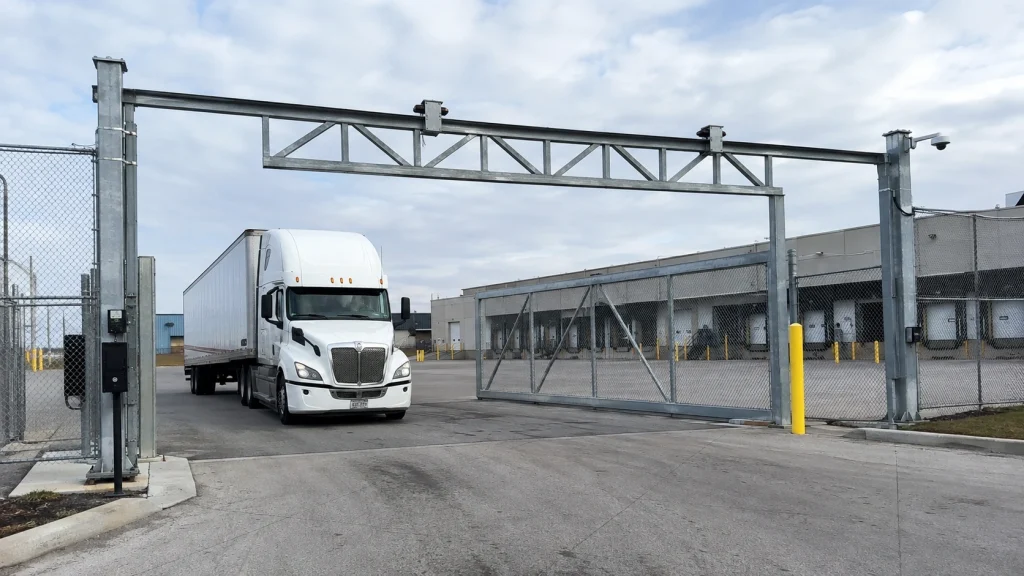
Overhead (Truss) Sliding Gates:The Fix for Sites With No Room to Slide
If you have ever stood at a job site staring at a 30-foot opening with buildings on one side, a fire hydrant on the other, and someone asking, "So where exactly is the gate supposed to go?" then you already know the pain this article is about.
Standard sliding gates need somewhere to park when they open. A cantilever gate needs even more room because the panel itself has to be roughly 50 percent wider than the actual opening to support itself on the rollers. Swing gates need a clear arc in front of or behind the opening. When your site has none of that extra real estate, you end up in a design jam that most fencing contractors either cannot or will not solve.
That is where overhead sliding gates come in. Also called truss gates, these are the product line that most Canadian fencing companies will not even bring up during the quoting process, simply because they have never installed one. But for the right project, an overhead truss gate is the only thing that actually works.
Let us break down what these gates are, why they matter in Canada specifically, and what every facility manager, project engineer, or general contractor should know before making a decision.
What Exactly Is an Overhead Sliding Gate?
At its simplest, an overhead sliding gate is a gate panel that hangs from a steel I-beam or structural track positioned above the opening. Instead of rolling along the ground on a track (like a standard sliding gate) or floating from side-mounted rollers (like a cantilever gate), the panel travels on trolley assemblies along this elevated beam.
The I-beam or truss structure extends over the opening itself and continues along the fence line on the receiving side, giving the gate somewhere to slide without eating up ground-level space on either side of the entrance.
These gates are built for heavy-duty commercial and industrial applications. The overhead truss structure keeps the gate aligned over long spans, prevents sagging, and allows smooth operation across openings of 20 to 40 feet or more. They can be fitted with chain link, welded mesh, or solid steel infill depending on the level of security and privacy required.
Why Most Fence Contractors Will Not Talk About This Product
Here is the honest truth. Overhead truss gates are more complex to engineer and install than a standard cantilever or track sliding gate. They require structural posts, a support beam capable of carrying the gate's full weight, and careful calculations for wind load, gate weight, and trolley placement.
Most residential and light-commercial fence companies simply do not have the engineering background or installation experience to take on this type of project. They will steer you toward a cantilever gate instead, and in many cases that is perfectly fine. But when the site conditions genuinely do not allow for a cantilever tail section or a ground-level track, the contractor's inability to offer an overhead solution becomes a real problem.
This is one of the reasons that Firm Fence, based in Etobicoke and serving projects across Ontario, has made overhead truss gates a core part of their product line. With over 45 years of experience in commercial and industrial fencing, they are one of the few contractors in the province who actually stocks, engineers, and installs these systems rather than subcontracting them out or avoiding the conversation entirely.
When Does an Overhead Gate Make More Sense Than a Cantilever?
Cantilever Gates
A cantilever gate is a great product. It floats above the ground on rollers, so snow and ice do not jam it up in winter. It does not need a ground track, which means it works on uneven terrain and gravel surfaces. For most industrial and commercial entrances in Canada, a cantilever gate handles the job well.
But a cantilever gate has one major limitation: it needs back clearance. Because the gate panel is longer than the opening it covers, you need clear fence line on the receiving side equal to about 150 percent of the opening width. For a 30-foot opening, that means roughly 45 feet of unobstructed fence line behind the gate.
On a sprawling industrial lot with hundreds of feet of perimeter, that is rarely an issue. But on tight urban sites, near building corners, next to loading docks, or at entrances squeezed between structures, you simply do not have that kind of room.
Overhead Truss Gates
An overhead gate solves this because the gate panel is the same width as the opening. There is no counterbalance tail that needs to stick out past the post. The entire mechanism lives above the opening, so the gate slides out of the way without demanding extra ground-level real estate.
The Canadian Winter Factor
Anyone who has managed a facility in Ontario, Alberta, or anywhere else in this country knows that winter is not just a season. It is an ongoing test of every piece of outdoor equipment on your property.
Ground-Track Sliding Gates
Ground-track sliding gates are notorious for freezing in place. Ice fills the V-groove track, snow packs around the wheels, and by mid-January you have maintenance crews out there with heat guns and shovels trying to get the entrance open for the morning shift.
Cantilever Gates
Cantilever gates handle winter much better because they float above the ground. But even cantilevers are not immune. Heavy ice can build up on the rollers. Frost heave can shift the support posts over time, throwing the gate out of alignment.
Overhead Truss Gates
Overhead truss gates have a real advantage here. Because the entire rolling mechanism sits well above ground level, snow and ice accumulation on the ground has zero effect on gate operation. The trolley assemblies ride along the elevated track far above the splash zone of road salt and slush. And the structural posts, when set properly below the frost line (at least 1.2 metres in most of Ontario, and deeper in Northern Ontario), resist seasonal heave the same way any well-engineered structure does.
For facilities that run around the clock, like distribution centres, trucking terminals, and transit depots, having a gate that reliably opens and closes in minus 30 weather without manual intervention is not a luxury. It is a basic operational requirement.
Real-World Applications Across Canadian Industries
Overhead truss gates are not for every entrance. They are specialized. But in the industries where they are needed, they solve problems that no other gate type can.
Trucking and Logistics Terminals
Trucking and logistics terminals are the most common application. These facilities often have openings of 30 feet or wider to accommodate tractor-trailers, and the entrances are frequently located between buildings with no room for a cantilever tail or a swing arc. An overhead gate spans the full opening, slides out of the way cleanly, and handles hundreds of cycles per day.
Airport Perimeter Security
Airport perimeter security is another area where overhead gates show up. Airside service roads and maintenance access points at Canadian airports require gates that can span wide openings, integrate with access control systems, and meet strict security protocols. The overhead design keeps the ground clear for vehicles and equipment while the gate operates above.
LRT and Transit Infrastructure
LRT and transit infrastructure projects across Canadian cities have created demand for gates that can be installed in very tight corridors alongside tracks, platforms, and electrical infrastructure. There is often no room for a gate to swing or for a cantilever to stack, but a perimeter still needs to be secured.
Hospitals and Medical Campuses
Hospitals and medical campuses need controlled access at service entrances, ambulance bays, and loading docks. Space is always at a premium on these sites, and an overhead gate provides security without interfering with emergency vehicle access or pedestrian pathways.
Secured Industrial Zones and Utility Compounds
Secured industrial zones and utility compounds round out the list. Whether it is a water treatment plant, an electrical substation, or a data centre campus, overhead truss gates provide perimeter control for openings that are too wide, too tight, or too heavily trafficked for any other gate type.
Automation and Access Control Integration
Nobody is manually sliding a 30-foot overhead gate open and closed a hundred times a day. These gates are almost always paired with motorized operators, typically chain-driven systems that can handle the weight and duty cycle required.
Modern automated gate systems can be integrated with RFID readers, keypads, intercom systems, loop detectors, cameras, and centralized security management software. For facilities that need to control who enters and when, an automated overhead gate connected to a proper access control system provides a level of security and auditability that a manual gate simply cannot match.
Safety features like photo-eye sensors, emergency release mechanisms, and battery backup systems are standard on most commercial installations. Battery backup is especially important in Ontario, where ice storms and power outages are a fact of life. A gate that locks up and will not open during an outage is not just an inconvenience; at a hospital or emergency services facility, it could be a life-safety issue.
For operators in cold climates, look for motor housings with built-in heaters. Some commercial operators are rated to function at temperatures as low as minus 40 degrees Celsius when equipped with a heater kit. Without one, most standard operators start to struggle at around minus 20.
Questions Canadian Facility Managers Should Be Asking
There are a handful of practical questions that come up regularly during the planning phase for overhead gate projects, but that few contractors or online resources bother to address.
What is the minimum overhead clearance required?
For most commercial overhead gates, the I-beam or track sits at roughly 14 feet above the ground surface. This allows standard semi-trailer traffic to pass underneath without issue. If your opening only needs to accommodate passenger vehicles or light trucks, the beam can sit lower, but always confirm clearance with your gate supplier before finalizing the design.
Can an overhead gate be installed on an existing fence line?
In many cases, yes. But the structural posts that support the overhead beam need to be engineered for the load. You cannot simply bolt an I-beam to a standard fence post and expect it to hold a 500-plus-pound gate panel. If you are retrofitting, plan on new post footings at minimum.
What kind of maintenance does an overhead gate need?
Less than a ground-track slider, more than a well-installed cantilever. The trolley wheels and bearings should be inspected and lubricated on a regular schedule. The track should be checked for debris or corrosion. The chain-drive system needs periodic tension adjustment. In harsh Canadian conditions, plan for at least two maintenance visits per year, ideally before winter and after spring thaw.
Do overhead gates meet Canadian security standards?
They can. When paired with the right fencing, access control, and barrier systems, an overhead gate can form part of a perimeter security package that meets or exceeds the standards required for government facilities, airports, and critical infrastructure. Firm Fence also offers high-security and crash-rated fencing systems for sites that need maximum perimeter protection.
Choosing the Right Gate for Your Site
Not every entrance needs an overhead gate. For many standard commercial and industrial openings, a well-built cantilever gate or a track-mounted sliding gate will do the job at a lower cost and with a simpler installation.
The decision really comes down to site conditions. If you have ample room along the fence line for a cantilever tail, go with a cantilever. If your ground is level and you can keep a track clear, a standard slider is economical and reliable. But if your site is tight, your opening is wide, and there is simply nowhere for the gate to go when it opens, an overhead truss gate is the answer.
The biggest mistake facility managers and general contractors make is not realizing that this option exists until they have already gotten three quotes for cantilever gates that do not fit the site. By that point, the project is behind schedule, the budget conversation gets awkward, and somebody ends up compromising on a solution that was never quite right for the location.
Why Firm Fence for Overhead Gate Projects in Ontario
Firm Fence has been providing commercial and industrial fencing solutions across Ontario since 1979. They handle everything from site evaluation and design through to installation and final inspection, and they carry the product lines and engineering experience to tackle projects that most contractors will not touch.
Their gate and barrier division covers sliding gates, cantilever gates, overhead truss gates, swing gates, barrier arms, crash-rated barriers, and full automation systems. That breadth of offering matters because the right gate for your project depends on your specific site, and you want a contractor who can recommend the best solution rather than the only solution they know how to install.


Ready to Talk Through Your Gate Project?
If you are planning a new perimeter, upgrading an existing entrance, or dealing with a gate opening that nobody can seem to figure out, it is worth a conversation.
Phone: 416-233-1811 | Email: kris@firmfence.com
61 Unit B Baywood Rd, Etobicoke, ON M9V 3Y8
Contact Firm Fence