
Chain Link vs. Welded Wire Fencing for Commercial Sites: Cost, Security, and Lifespan Compared
If you have ever specced perimeter fencing for a distribution yard off the 401, a substation outside Sudbury, or a mixed-use development in Etobicoke, you already know the chain link versus welded wire question is anything but academic. It shows up in every submittal package, every risk review, and every value engineering meeting. Get it wrong and you either overbuild by forty percent or you are back on site within five years replacing sagged fabric, wind-damaged top rails, and rusted-through terminal posts.
What each system actually is
Chain Link
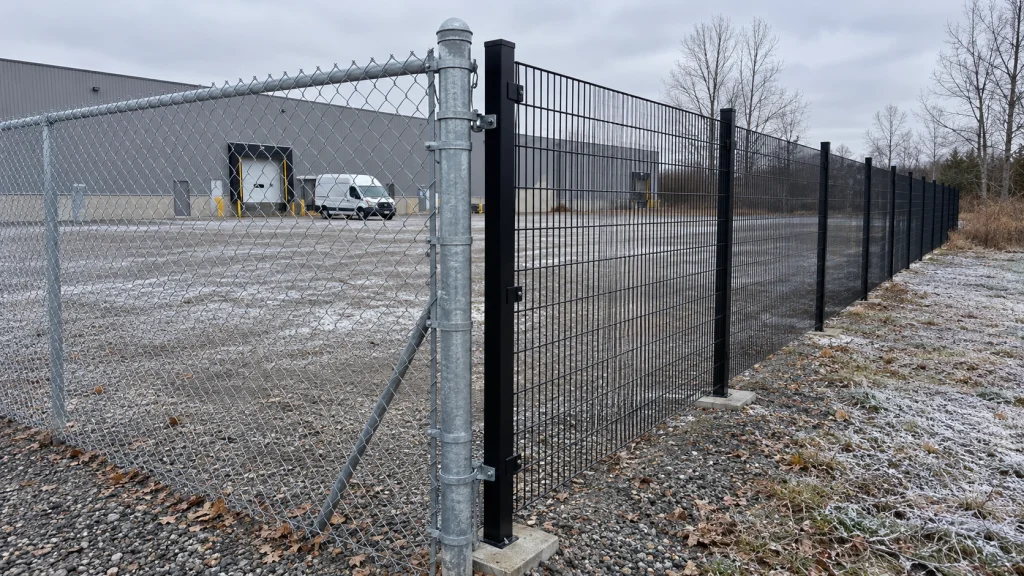
Chain link fabric is woven from steel wire pickets bent into a helical spiral and interlocked into a diamond pattern. Commercial grade fabric in Canada is normally 9 gauge (0.148 inches / 3.76 mm core wire) with a 2 inch mesh opening, tested to ASTM A392 for zinc coating or ASTM F668 for polymer coated systems. The framework is Schedule 40 hot-dip galvanized steel pipe per ASTM F1083. Higher risk sites step up to 6 gauge fabric (0.192 inches / 4.88 mm) and mini-mesh (1 inch or 3/8 inch aperture) to eliminate finger and toe holds.
Welded Wire
Welded wire is a completely different animal. Straight horizontal and vertical wires are resistance welded at every intersection, producing a rigid panel that will not sag, unweave, or flex. Panels are typically 8 feet wide. Formats range from light commercial 2 x 1 inch aperture through to the 358 profile, which is 76.2 x 12.7 mm openings in 4 mm galfan coated wire. The 358 profile is specified on serious perimeter jobs because the openings are too small for a hand or boot to gain purchase, and the welded joints will not yield to standard bolt cutters. Panels arrive with polyester powder coat over hot-dip galvanized substrate, so the finish is factory controlled rather than field applied.
Cost, in real Canadian dollars
For a 6 to 8 foot commercial run, installed prices across Ontario in 2026 look roughly like this:
Chain link, 9 gauge galvanized, Schedule 40 framework, standard tension wire top and bottom: $25 to $45 per linear foot installed. Add barbed selvage, a three strand outrigger, or razor coil and you add another $8 to $15 per foot. Vinyl coated fabric (PVC over galvanized core) adds roughly 15 to 25 percent.
Welded wire panels, standard commercial anti-climb aperture, powder coated, mounted on structural posts: $45 to $95 per linear foot installed. Move up to 358 or twin-wire 868 systems and you are looking at $110 per foot and up before any security toppings.
Gates, automation, and site prep sit outside those numbers. A single 20 foot cantilever gate with automated operator, loop detectors, and access control integration will run $18,000 to $35,000 depending on platform, and that math does not care which mesh you selected for the perimeter.
The trap in cost comparison is treating this as a per-foot decision. On a 1,000 foot warehouse perimeter, the delta between chain link and welded wire is often $30,000 to $50,000. That number has to be weighed against loss exposure, insurer requirements, and how many decades the asset needs to sit behind that fence.
Security: what each mesh actually stops
Chain link is a deterrent, not a barrier. An experienced intruder with a 24 inch bolt cutter is through standard 9 gauge fabric in under a minute. Its security value comes from what you add on top: barbed selvage instead of a knuckled edge, three strand outrigger, or coiled concertina. For sites storing electronics, pharmaceuticals, non-ferrous metals, cannabis, or automotive inventory, chain link alone is insufficient. Insurers know this. Cargo theft carriers are increasingly writing coverage terms that reference specific fence types.
Welded wire, particularly the 358 profile, is a physical barrier. The apertures are too small for a hand to grip, the welds resist common tool attack, and the panels do not deform enough to allow crawl-under intrusion. LPS 1175 ratings (typically A1 / SR1 for standard 358, B3 / SR2 for enhanced twin-wire systems) are increasingly written into Canadian utility, transit, and data centre specifications. If your project has any regulatory security overlay, the burden of proof is much easier to carry with a rated welded panel than with woven chain link.
Lifespan under Canadian conditions
This is where a lot of specifications go sideways. Ontario freeze-thaw cycles, prairie wind loading, and coastal salt spray each attack fencing differently.
Galvanized chain link installed correctly on 1.2 metre (4 ft) minimum footings in Southern Ontario, with Schedule 40 posts and Class 2 zinc coating (2.0 oz/ft²), typically delivers 20 to 25 years before major refurbishment. Cut that to 12 to 18 years within 500 metres of a major salted arterial or in coastal BC and Atlantic Canada.
Welded wire with galfan or Class 2 zinc plus polyester powder coat delivers 25 to 35 years realistically. There is no woven picket to loosen, no top rail dependency to hold the fabric in profile, and less wind flap fatigue at connections.
Frost heave is the silent killer of both systems. Footings shallower than the local frost line will lift and refreeze, throwing posts out of plumb within two winters. In most of Southern Ontario, that means 4 feet below grade at a minimum. Northern Ontario and the prairies need 5 to 6 feet. Do not let a contractor talk you into 3 foot footings to save on augering.
Aesthetics and architectural fit
Chain link reads industrial. Black PVC coated fabric on black powder coated framework softens it for commercial parks and municipal sites, but no one is calling it architectural. Welded wire reads intentional. The clean horizontal and vertical grid works with modern facade materials, integrates well with steel bollards and site lighting, and often clears design review committees on mixed-use sites where chain link would be rejected outright. For projects with public street sightlines, transit corridors, or LEED-referenced sites, welded wire is usually the defensible choice.
Questions Canadian owners keep asking that most contractors will not answer
Does welded wire drift snow like a snow fence?
Yes, more than chain link. On exposed north-facing runs in the prairies and rural Ontario, plan for it. Chain link's larger aperture lets wind pass. Tight welded mesh does not.
Do I need a permit?
In most Ontario municipalities, any commercial fence over 2 metres requires a permit, and any fence within a corner sight triangle or road allowance is triggered regardless of height. Toronto, Mississauga, and Hamilton each have their own quirks. Check the municipal bylaw before ordering material.
Can I put welded wire on sloped grade?
Yes, but panels have to be stepped or custom raked at the factory. Chain link is more forgiving on grade because the fabric flexes. Budget for factory customization if your site has significant slope.
Will my property insurance care which one I install?
Increasingly, yes. Cargo, cannabis, and metals recycling policies now reference specific mesh types and heights. Get the insurance requirements before you spec the fence, not after.
How does salt spray affect the coating?
Powder coat over galvanized substrate is your best defence. Spec touch-up paint kits for any field cuts. Never leave a cut end exposed on a coastal or salted highway site.
When to choose which
Chain link earns its place on storage yards, construction staging areas, low risk commercial lots, and straightforward property line demarcation. It is fast to install, forgiving on grade, and cost effective at scale.
Welded wire belongs on high value asset sites, sensitive facilities, regulated infrastructure, and any project where the perimeter contributes to the architectural expression. The upfront premium is real. So is the extra fifteen years of service life and the significantly harder time an intruder is going to have getting through it.
plainFeatured Firm Fence Solutions
For commercial and industrial projects across the GTA and Ontario, the following Firm Fence product lines cover the full spectrum:
plain
Galvanized or vinyl coated finish, Schedule 40 framework, and configurable toppings for barbed or razor security applications.

Anti-climb mesh design, powder coated architectural finish, and rigid panel construction engineered for high security perimeters and clean sightlines.

Site-specific gates, bollards, security enclosures, and hybrid systems where standard product lines will not meet the design intent.

Swing, sliding, cantilever, and overhead truss configurations, integrated with RFID, keypad, intercom, and remote access control platforms.
Firm Fence has been building commercial perimeters across Toronto and Ontario since 1979. If you are working on a specification that needs to survive both a security audit and a Canadian winter, that is the depth of field experience worth having in the conversation early, not after the pour.
