
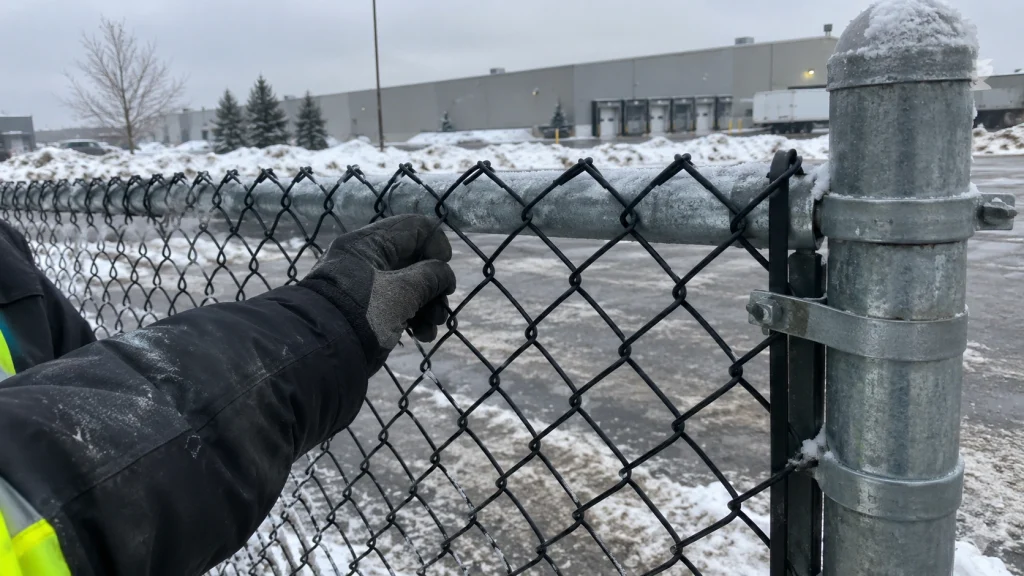
Galvanized vs. Galvalume vs. Vinyl-Coated Chain Link: Which Holds Up Best in Ontario Weather
If you've ever walked a commercial site in Mississauga in mid-February and looked closely at a five-year-old chain link fence, you already know the answer isn't as simple as the spec sheet makes it sound. Ontario weather is a coating killer. Between freeze-thaw cycles, road salt spray drifting off the 401, ice storms, UV in July, and 90% humidity in August, the finish on your fence fabric does more work than the steel underneath it.
Whether you're a contractor bidding a warehouse perimeter in Vaughan, an architect specifying a schoolyard enclosure in Hamilton, or a homeowner in Etobicoke trying to figure out why the neighbour's fence rusted in seven years and yours might not, the finish you pick matters more than the gauge you pick. Here's a straight comparison of the three most common options, written the way a spec should be read.
What each coating actually is
Let's get the metallurgy out of the way, because most articles online skip this and go straight to "vinyl looks nicer."
Galvanized (GBW vs. GAW)
Galvanized chain link is zinc-coated steel wire. Two production methods exist. Galvanized Before Weaving (GBW) draws the wire, dips it in molten zinc, then weaves it into fabric. This is the industry standard and meets ASTM A392. The trade-off is that the shear points where the wire is cut and knuckled during weaving expose bare steel, which is where rust typically starts.
Galvanized After Weaving (GAW) weaves first, then dips the finished fabric, giving full coverage including cut ends. GAW is more expensive and less common in Canada but noticeably better in wet or salt-heavy environments. Zinc coating weight is measured in ounces per square foot. Class 1 is 1.2 oz/ft², Class 2 is 2.0 oz/ft². For anything commercial in Ontario, spec Class 2 or don't bother.
Galvalume
Galvalume, technically a trademarked coating owned by BIEC International, is a hot-dip metallic layer of approximately 55% aluminum, 43.4% zinc, and 1.6% silicon. In the fence industry in Canada, you'll most often see it on frameworks, terminal posts, and top rails rather than on the mesh fabric itself. The aluminum content forms a stable oxide barrier, while the zinc provides sacrificial (galvanic) protection at cut edges and scratches.
Field data from the roofing industry, where Galvalume is dominant, shows corrosion life two to four times longer than G90 galvanized in comparable exposures. If your specification calls for a "Galvalume chain link fence," what you're usually being sold is a galvanized fabric mounted on a Galvalume or Zincalume framework, often finished with a polyester powder coat. Ask your supplier to confirm exactly which components carry which coating. Vague answers here are common and expensive later.
Vinyl-Coated (ASTM F668)
Vinyl-coated chain link is galvanized fabric with a PVC or LLDPE polymer coating extruded or fused over the wire. The standard is ASTM F668, which defines three classes. Class 1 is extruded only (loose sleeve, cheapest, prone to peeling and moisture wicking underneath), Class 2a is extruded and adhered with an adhesive layer, and Class 2b is thermally fused and bonded.
For any project where the coating is a specified performance layer rather than a paint job, Class 2b is the only defensible choice. It costs more, but it's what school boards, correctional facilities, and municipal parks departments across Ontario put in their master specs for a reason.
How each performs in Ontario weather
Road salt and chloride exposure.
This is the single biggest variable most Canadian specs ignore. If your fence is within roughly 15 metres of a road that gets winter salt, chloride spray is going to hit it. Zinc reacts with chlorides to form zinc chloride, which is water-soluble and washes away, accelerating coating loss. Standard galvanized fabric in a high-salt exposure zone in the GTA can start showing white rust within three to five years and red rust within seven to ten. Aluminum-zinc coatings (Galvalume framework) resist chlorides significantly better because aluminum forms a passive oxide film that isn't chloride-soluble. Vinyl-coated fabric is the best barrier against salt spray, provided the coating stays intact. If the vinyl gets nicked by a snowplow or a lawn edger, moisture and chlorides get trapped underneath and corrosion accelerates faster than on bare galvanized. Class 2b fused coatings resist this failure mode much better than Class 1.
Freeze-thaw and thermal cycling.
Southern Ontario averages 100 to 130 freeze-thaw cycles per year. Metals expand and contract at different rates than polymer coatings. Cheap Class 1 vinyl coatings, particularly on lighter 11.5 gauge residential rolls, can develop hairline cracks within five to eight winters. Galvanized zinc coatings don't care about thermal cycling. Galvalume is likewise unaffected mechanically.
UV degradation.
PVC coatings without proper UV stabilizers chalk and fade within three to five summers of full southern exposure. Reputable manufacturers add titanium dioxide and other UV inhibitors, but colour retention still varies. Black vinyl generally holds colour longest because carbon black is an excellent UV absorber. Green and brown fade more visibly. Galvanized and Galvalume finishes are unaffected by UV.
Snow load and ice loading.
This is a structural conversation more than a coating one, but the finish choice interacts with it. A snow-loaded chain link fabric flexes at every diamond. Class 1 extruded vinyl, which is essentially a loose sleeve, tends to migrate along the wire under repeated flex. This is why you sometimes see bunched vinyl at the bottom of an older fence. Fused-and-bonded and galvanized fabrics don't do this.
Questions Canadian consumers keep asking that no one answers straight
Is my fence pool-code compliant?
Ontario Building Code (through the applicable municipal pool enclosure bylaw) generally requires a minimum 1.2 metre height for pool enclosures, with a maximum mesh opening of 38 mm (about 1.5 inches). Standard 2-inch mesh chain link does not comply for pool enclosures on its own. You need a smaller mesh (1-3/4 inch or tighter) or slat inserts. Any of the three finishes can be spec'd in a compliant mesh size, but check your specific municipal bylaw. Toronto, Oakville, and Vaughan all differ slightly.
Does my Toronto property have a height limit?
Residential rear-yard chain link is generally capped at 2.0 metres, and front-yard at 1.2 metres under Toronto Municipal Code Chapter 447. Corner lots and daylight triangles have stricter rules. A contractor who doesn't ask about your zoning before quoting is a contractor to avoid.
How long is the warranty actually good for?
Read it. Most manufacturer warranties on vinyl coatings exclude damage from de-icing salts, impact, and improper installation. Meaning: exactly the failure modes most likely to occur in Ontario. Warranty length is a marketing number more often than a performance guarantee.
Will Galvalume framework really outlast galvanized?
In salt-adjacent applications, yes, meaningfully. In inland, dry, low-salt sites, the difference is smaller and the payback period on the price premium stretches out.
Ballpark pricing (materials only, GTA, 6-foot fabric)
Galvanized Class 2, 9 gauge: roughly $3.50 to $5.00 per linear foot for fabric. Galvalume framework with galvanized fabric: adds roughly 15 to 25% over standard galvanized. Class 2b fused-and-bonded vinyl over 9 gauge core: roughly $6.50 to $9.00 per linear foot for fabric.
These are 2025 material estimates for the GTA supply market and shift with steel and zinc commodity pricing. Get three quotes.
What Firm Fence typically specs, and where to see it
Firm Fence has been installing across the GTA since 1979, and the field data from that many Ontario winters shapes what we recommend for different applications.
Residential backyards, dog runs, and pool enclosures: our vinyl-coated (Class 2b) chain link systems in black or green blend into landscaping better than raw galvanized and hold up well in typical suburban salt exposure.
Commercial and industrial perimeters, warehouses, distribution centres: we typically spec 9 gauge Class 2 galvanized fabric on a Galvalume or heavy hot-dipped galvanized framework, with the option to add barbed wire or razor ribbon on top.
High-security sites, transformer yards, cannabis facilities, crash-rated applications: welded wire or crash-rated systems typically outperform chain link, regardless of finish.
If you want a straight, spec-level conversation about what belongs on your specific site given its exposure, drainage, and load requirements, call Firm Fence at 416-233-1811 or visit firmfence.com. Bring your site plan and your bylaw questions. That conversation will save you more than the coating premium ever will.
Get a Straight Answer for Your Site
Bring your site plan and your bylaw questions. Firm Fence has been installing across the GTA since 1979.
Visit Firmfence.com