
Custom Fabrication: When Off-the-Shelf Fencing Won’t Meet Your Site’s Specs
Anyone who has spec'd fencing for a Canadian project knows the moment. You open the manufacturer catalogue, find a panel that almost works, then check the site drawings and realise the standard 8-foot bay leaves a 14-inch gap at the transformer pad, or the grade change is too steep for pre-punched rails, or the client wants a 3.6 m clear opening and the widest cantilever kit tops out at 3.05 m.
Off-the-shelf fencing solves the middle 70% of Canadian sites. The other 30% needs someone with a shear, a press brake, a MIG welder, and a shop foreman who understands the Ontario Building Code. That is where custom fabrication earns its cost.
Where Stock Product Runs Out of Runway
Most catalogue fencing is engineered for a specific set of assumptions: flat run, standard bay length, temperate climate, no unusual wind exposure, and a boundary that follows a clean property line. Real Canadian sites break every one of those assumptions on a regular basis.
A few examples of when the box product stops working:
Grade changes over roughly 6% (about a 1:16 slope).
Racked panels absorb a small amount, but on GTA ravine lots or Prairie hillsides you either step the fence, custom-rake the pickets, or accept ugly triangle gaps. Custom-fabricated ornamental panels can be cut to grade so the top rail follows a true horizontal line while pickets stay plumb.
Non-standard heights.
Municipal bylaws in Toronto, Calgary, and Ottawa each cap residential fence heights differently, but private developments regularly ask for a 2.44 m security height with a top-mounted 45-degree extension arm for barbed tape or Cobra coil. That is not a stock SKU.
Hydro corridor, rail-adjacent, and utility substation work.
These usually require bonding lugs, specific mesh apertures, and CSA-compliant grounding. Fabricators build to the utility's own drawing package, not a manufacturer catalogue.
Heritage overlays.
Downtown Toronto, Old Montreal, and Old Strathcona often demand pickets, finials, and scroll patterns that match an existing historical fence. There is no online store for that.
Wide gate openings.
Standard cantilever gate kits from the major US suppliers max out around 3 m clear opening. If your site needs 6 or 9 m clear for a tractor-trailer turning circle, you need a fabricated truss gate with a properly sized bottom track and V-groove roller assemblies rated for the actual leaf weight.
The Technical Basics an Architect or Contractor Should Actually Specify
If you are writing a spec for a fabricated system, avoid vague language. "Heavy-duty" is not a spec. These are:
Base material.
Hot-rolled steel tube (commonly 1-1/2" or 2" square, 11 or 14 gauge for pickets; 4" or 6" IPS schedule 40 for terminal and gate posts), 6063-T6 aluminum, or 304/316 stainless for coastal BC and Maritime installations.
Finish.
Hot-dip galvanized to CSA G164 or ASTM A123, followed by a TGIC polyester powder coat. This is called a duplex coating system, and in southern Ontario road-salt exposure it can double or triple service life compared to powder coat over primer alone.
Welding.
MIG for structural picket-to-rail connections, TIG for exposed architectural welds where the finish shows. All welds should be ground, primed, and topcoated after fabrication, not before.
Wind load.
NBC 2020 climatic data or Ontario Building Code Supplementary Standard SB-1 gives you the 1-in-50 hourly wind pressure for your site. A 2.4 m high solid privacy panel in Etobicoke, for example, sees roughly 0.44 kPa of design pressure. That drives post spacing, footing diameter, and welded connection strength.
Footing depth.
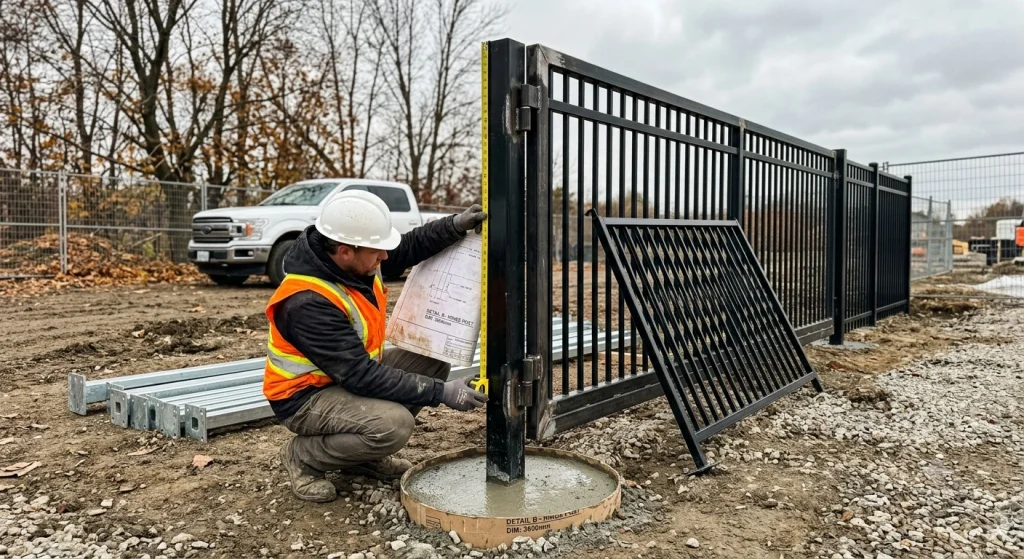
Below the local frost line. In the GTA that is a practical minimum of 1.2 m; most commercial fence contractors bury terminal and gate posts 1.4 to 1.8 m deep in bell-shaped concrete footings with a gravel drainage base. Ottawa and Montreal often push 1.5 to 1.8 m. Prairie sites can hit 2 m or more.
If a supplier cannot answer questions on those items in plain language, they are reselling, not fabricating.
Questions Canadian Clients Rarely Ask (and Really Should)
The industry does not love talking about these, but they show up on every job.
Who actually owns the fence?
On a shared property line in Ontario, the Line Fences Act (RSO 1990, c. L.17) still governs disputes when a neighbour will not split the cost of a boundary fence. It gets ignored constantly on custom residential builds, and it becomes a problem the day the homeowner installs a fabricated aluminum fence directly on the line without a signed acknowledgement.
Will custom work affect my insurance?
Commercial insurers in Canada increasingly ask for perimeter details before renewal, especially for warehouses and cannabis facilities. A custom fence that is not documented (shop drawings, materials list, installer credentials) can create claim friction after a break-in. Ask your fabricator for a stamped shop drawing package. It is cheap insurance for your insurance.
What is the honest lead time?
Domestic fabrication in the GTA typically runs 3 to 6 weeks for standard ornamental work and 8 to 12 weeks for crash-rated or fully automated systems. Offshore-fabricated gates can take 10 to 16 weeks after tariffs, ocean freight, and CBSA clearance. If a contractor promises a custom 9 m cantilever gate in two weeks, ask what corners are being cut.
Powder coat or galvanized?
Both, ideally. Powder coat alone looks great for the first three winters and then starts checking at the welds where salt creeps under the finish. Duplex (galvanized substrate under powder coat) is the honest long-life answer, and it usually adds only 15 to 20% to material cost.
Does the automated gate meet UL 325 and ASTM F2200?
If it is powered, it has to. Vehicle gate operators sold and installed in Canada are expected to comply with UL 325 entrapment protection zones and the ASTM F2200 gate construction standard. Any fabricator building automated gate leaves should be designing them with both documents open on the desk.
Featured Fabricated Solutions
A quick tour of what a properly equipped Canadian fab shop can deliver, drawing on Firm Fence's own product categories.
Custom Fabrication and Specialty Solutions: Bollards, security enclosures, architectural fence systems, and site-specific panels built to shop drawings. Best for one-off work where no stock product fits.
Welded Wire Fencing: Rigid anti-climb 358 mesh (76.2 mm x 12.7 mm aperture) fabricated into panels for utility, cannabis, and institutional perimeters where visibility and climb resistance both matter.
High-Security and Crash-Rated Fencing: Reinforced steel systems engineered to meet ASTM F2656 impact ratings for sensitive infrastructure.
Crash-Rated Barriers: K4, K8, and K12 rated bollards and wedge barriers (equivalent M30, M40, M50 under ASTM F2656) for government, energy, and airport airside applications.
For a submittal package, ask the supplier to send high-resolution product photography and past project shots from these pages. Serious fabricators keep a project photo library and will provide it on request.
How to Choose the Right Fabricator
Three quick filters that separate a real shop from a rebadger:
Do they own fab equipment (shear, brake, welders, powder booth), not just a distribution warehouse?
A ten-minute shop tour answers this.
Can they produce stamped shop drawings and material certifications on request?
Do they have a decade or more of Canadian project history, so they understand frost, road salt, wind loading, and municipal permit realities?
Firm Fence has been fabricating and installing across Ontario since 1979. That puts them in a small group of Canadian shops that have watched the codes evolve, the materials change, and the security expectations rise since the 1980s. When a site's specs do not match anything in the catalogue, that kind of history is worth more than any brochure.
Bottom Line
Off-the-shelf fencing is cheap and fast when the site cooperates. When it does not (steep grade, oversized opening, unusual security profile, heritage requirement, or a client who wants something no one else has built) custom fabrication is not a luxury. It is the reason the fence still stands, still works, and still looks the way the drawings promised, five winters after the ribbon cutting.
