
Do You Need a Permit for Commercial Fencing in Toronto and the GTA? A Municipality-by-Municipality Guide
If you have ever heard a contractor say "you don't need a permit for a fence in Ontario," they were half right. For a standard six foot backyard fence at a bungalow in Etobicoke, no permit. For a nine foot galvanized chain link perimeter around a logistics yard in Vaughan, with barbed wire arms and a cantilever gate on the truck court, that is a completely different conversation.
The confusion costs money. We have seen stop work orders on nearly finished perimeters, redesigns after site plan review, and gates that had to be pulled and re-hung because a sight triangle was clipped. This guide breaks down what actually triggers a permit for commercial, industrial, and institutional fencing across the GTA, and where the traps sit that even seasoned property managers miss.
Why Commercial Fencing Is a Different Animal
Commercial fence work in Ontario rarely lives under a single "fence permit." Approval usually comes through one or more of these layers:
1. The municipal fence by-law. Every GTA city has one. It sets maximum height, prohibited materials (barbed wire, razor wire, electrification), sight triangle rules on corner lots, and how you apply for an exemption when the site needs something taller or different.
2. The zoning by-law. Different height allowances apply to residential, commercial, industrial and institutional zones. Industrial zones typically permit taller fences and barbed wire toppings that a residential zone would never allow.
3. Site plan control (SPA). If your project is a new build, an addition, a change of use, or a re-development, the fence is almost always specified inside the site plan approval package. The municipality reviews landscaping, screening, security, waste enclosure gates, loading area buffers, and perimeter treatment together. Your fence gets approved as part of the drawings, not separately.
4. Ontario Building Code (OBC). Pool enclosures, guards on retaining walls, and any structural element attached to a building will pull the OBC in.
5. Conservation authority approval. If any part of your site is within a regulated area under TRCA, CVC or CLOCA, that agency has to sign off before you drive a single post. Regulated areas cover floodplains, wetlands, valley lands and shoreline zones. This one gets missed constantly on infill sites.
6. Heritage or urban design approvals. If the property sits in a heritage district or a design district, expect additional review of materials, colour and picket profile.
Toronto
Chapter 447 of the Toronto Municipal Code is the governing fence by-law. Residential fences generally cap at 2.0 metres in side and rear yards and 1.2 metres in front yards, with no permit required unless you exceed those limits or are enclosing a pool.
For commercial, industrial and institutional properties, the height caps in Chapter 447 do not apply the same way. Zoning by-law 569-2013 controls those situations, and heights in the 2.5 to 3.0 metre range are routinely acceptable in industrial zones. Barbed wire and razor wire are prohibited under Chapter 447 unless the fence exceeds 2.5 metres and the barbed strand sits above 2.5 metres on brackets angled 45 degrees inward. That last detail catches people. You cannot just weld three strands on top of a six foot chain link at an industrial site. The base fence has to be tall enough first.
Fence exemption applications currently sit at $200. A pool enclosure on a commercial property (think a hotel or condo amenity) needs a separate Pool Fence Enclosure Permit through Toronto Building.
Mississauga
Fence By-law 0397-1978 (as amended) sets a 2.0 metre general maximum for residential and commercial yards. Industrial land, railway rights of way, hydro corridors and public works installations are exempt from that residential cap. A fence exemption application currently runs about $361.20 including HST. New builds go through Site Plan Approval where fence details are locked in on the landscape drawings. Barbed wire is prohibited except on land used for industrial purposes.
Brampton
Zoning By-law 270-2004 caps residential yard fences at 2.0 metres in the rear and side and 1.0 metre in the front. Commercial and industrial heights are governed by the applicable zoning designation and site plan. Brampton also has a Subdivision and Site Plan Fencing and Wall Standards manual that specifies pre-cast concrete walls next to industrial outdoor storage in some contexts. If you are doing perimeter work on a site under a subdivision agreement, that manual is the document your design team should be pulling.
Vaughan
Fence By-law 80-90 (as amended) is the reference. Standard residential caps sit at 2.0 metres in side and rear yards. Non-residential heights are governed by the zoning by-law and site plan. Height exemption applications are common, and the city keeps records showing average requested rear yard heights around 2.29 metres. Barbed wire, electrified fencing, and so-called "spite fences" are prohibited.
Markham
Fence By-law 2017-30 sets 2.4 metres as the general side and rear yard maximum for residential, with 1.0 metre for solid front yard fences and 1.5 metres for open construction. Commercial and industrial heights fall under the zoning by-law. Pool enclosure permits are processed through Building Standards and currently run around $295. Corner sight visibility triangles are strictly enforced at 6 metres by 6 metres, with a 0.9 metre height cap inside the triangle.
Richmond Hill, Oakville, Burlington, Milton
Each of these municipalities operates its own fence by-law (Richmond Hill Chapter 973, Oakville By-law 2002-034 as amended, Milton By-law 97-2005 among others). The pattern is consistent. Residential heights are prescribed in the fence by-law. Commercial, industrial, and institutional heights are set through the zoning by-law and site plan. Pool enclosures are separately permitted.
The Questions Nobody Answers Properly
A few items that come up on almost every commercial project and rarely get discussed clearly.
Site plan control is the real gate.
On a new commercial build or a significant change, the fence is not a separate line item. It is drawn, specified, and approved as part of the SPA drawings. If you install a fence before that approval is issued, or install something different from what was approved, you can be ordered to remove it. Architects and contractors should confirm what the approved drawings say before mobilizing.
Corner sight triangles trump everything.
Sight triangles are non-negotiable for traffic safety. Even a solid fence that meets height caps everywhere else can be flagged inside a corner lot triangle.
Conservation authority screening.
TRCA, CVC and CLOCA regulations apply to any work within their regulated limits, including fence installation. This is common on properties backing onto ravines, creeks, or Lake Ontario shoreline. Skip this step and you can end up with a compliance order and remediation costs.
Utility easements.
Bell, Enbridge, Hydro One, Toronto Hydro and Alectra all hold easements that restrict what can sit above their infrastructure. A permanent fence across a hydro easement is often not allowed at all.
Automated gates.
Anything motorized has to comply with UL 325 for entrapment protection and the applicable ASTM standards for gate construction. This is not a by-law issue, it is a life safety and insurance issue. It matters more than the permit.
Barbed wire and razor wire.
Generally prohibited on residential and commercial land in most GTA municipalities and generally allowed on industrial with height thresholds. Verify against the specific zoning by-law before quoting.
Neighbouring property notification.
Some municipalities notify adjoining owners on exemption applications. Build that timeline into your schedule.
Recommended Products for Commercial and Industrial Sites
The products below are all from Firm Fence and are matched to the situations described above.
1. Chain Link Fencing
Best for: industrial perimeters, logistics yards, construction laydown areas, storage compounds.
Why: cost effective per linear foot, easy to top with barbed strand arms where zoning allows, easy to integrate cantilever gates. View the chain link fencing product page.
2. Ornamental Steel and Aluminum Fencing
Best for: office campuses, condo amenity boundaries, institutional sites, front elevations of industrial buildings that face a public road.
Why: meets urban design review expectations, higher perceived security than chain link, powder coat finishes last in Ontario freeze thaw. Learn more.
3. Welded Wire Fencing
Best for: data centres, pharmaceutical distribution, utility substations, any site needing anti-climb performance with visibility.
Why: rigid panel system resists cutting and climbing more effectively than chain link. Explore welded wire fencing.
4. Cantilever Gates
Best for: truck courts and yards with uneven grade or snow accumulation, where a ground track is not practical.
Why: no ground track to plow around, smooth operation, pairs with automation. See cantilever gates.
5. High Security and Crash Rated Fencing
Best for: critical infrastructure, government facilities, data centres, and any site with a formal threat assessment.
Why: engineered to ASTM and DoD impact standards, resists forced vehicle entry. View high security fencing.
6. Automated Gate Systems and Barrier Arms
Best for: managed access control at office parks, industrial complexes, and multi tenant sites.
Why: integrates with RFID, keypads, intercoms and cameras, and complies with UL 325 for entrapment protection. Explore automated gate systems.
Final Word
The permit question for commercial fencing in the GTA is rarely a yes or no. It is a stack: fence by-law, zoning, site plan, OBC, conservation authority, easements, heritage. Miss one and the project stalls.
The Safest First Step
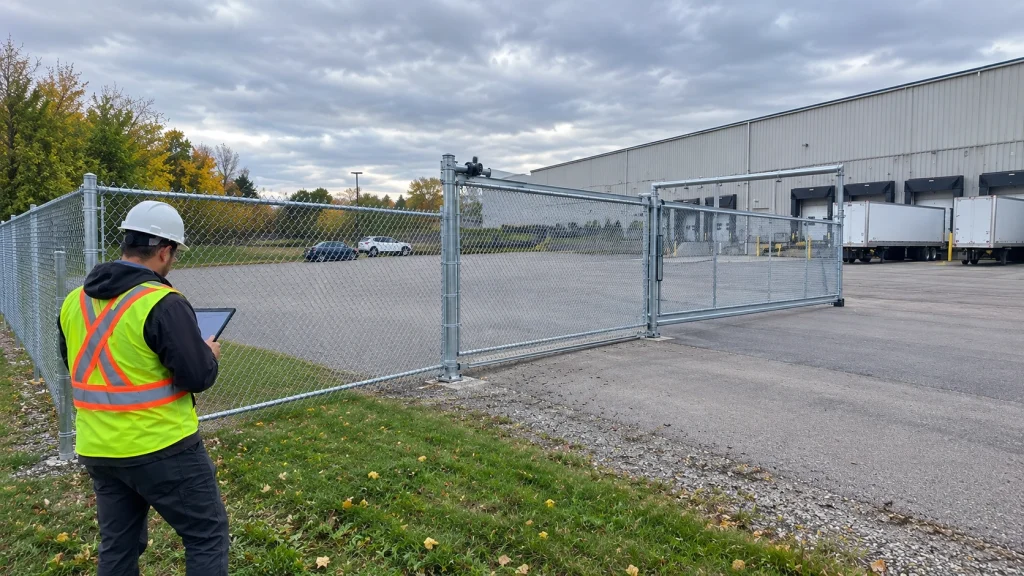
If you are an architect finalizing a landscape package, a contractor pricing a perimeter, or a property owner scoping a security upgrade, the safest first step is a site walk with a commercial fence contractor who reads by-laws for a living. That conversation is usually free. The stop work order is not.
Book a Site Walk