
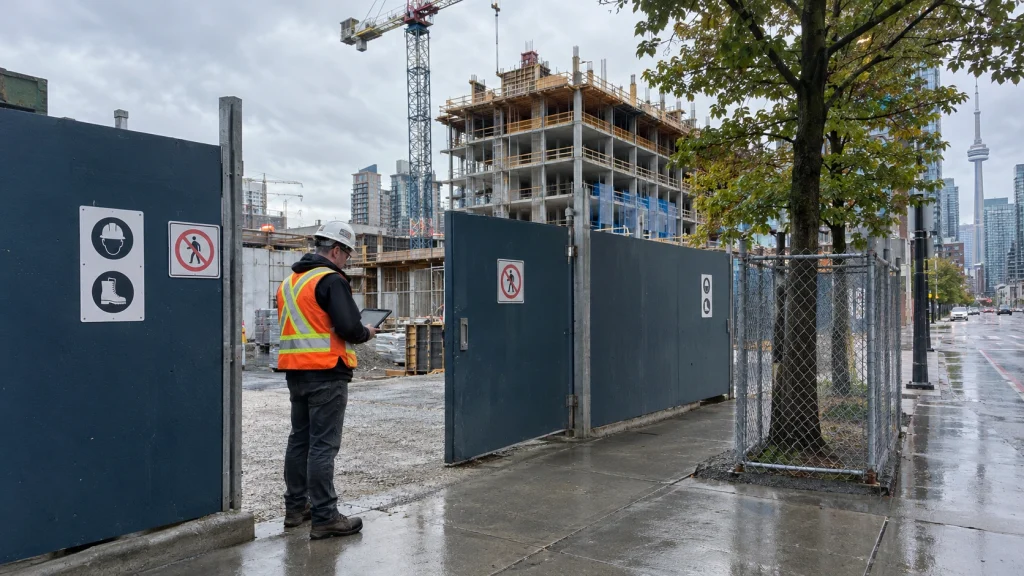
Construction Site Hoarding and Fencing Rules in Ontario: What GCs Need Before Mobilization
If you have ever had a site inspector show up before the sod cutting and shut down mobilization over a fence that was six inches too short, you already know why this article exists. In Ontario, hoarding and site fencing look like the simplest line on the schedule of values, right up until they become the reason your crane pick gets pushed a week and your insurance carrier starts asking pointed questions. Whether you are a general contractor bidding a mid-rise in Etobicoke, an architect coordinating site logistics for a heritage retrofit in Cabbagetown, or a homeowner running a custom infill in Leaside, the same rulebook applies. Getting it right is cheaper than the alternative.
Here is what actually governs your perimeter, what it costs, and where most projects get tripped up.
The Regulatory Stack You Are Actually Working Under
Ontario runs a three-layer system for construction perimeters, and every layer has teeth.
The Occupational Health and Safety Act (OHSA) is the parent statute. It requires every constructor to take every reasonable precaution to protect workers and the public. That language is broad on purpose. Inspectors from the Ministry of Labour, Immigration, Training and Skills Development use it to backstop nearly every enforcement action.
Ontario Regulation 213/91 (Construction Projects) is where the specifics live. Section 65 is the one most people quote incorrectly. It requires a sturdy fence at least 1.8 metres in height between any public way and a project where the work may endanger a member of the public. Notice the language. Not "if you feel like it," not "if a passerby complains." If the work could endanger the public, the fence is mandatory. Section 64 covers covered ways, which most sites need the moment scaffold work or overhead operations begin near a pedestrian route. Subsection 233(4) is the one that gets missed on excavation: a barrier at least 1.1 metres high at the top of every unsupported excavation wall, which is separate from your perimeter fence.
Municipal bylaws sit on top. Toronto works under Chapter 743 (Streets and Sidewalks) and Chapter 441 (Fees and Charges), with hoarding permits administered through Transportation Services. Other municipalities have their own frameworks. Ottawa uses Building By-law 2014-220 and its Site Alteration By-law. Mississauga, Vaughan, and Hamilton each run separate hoarding permit processes.
The 1.8 Metre Rule Is Not the Whole Story
Height is the headline number, but the failure points sit elsewhere.
Openings in your fence cannot exceed 150 mm in width, and the bottom gap cannot be more than 150 mm above grade in most municipalities. That kills the "we will just tuck the panel in and use zip ties" approach that some subs still try. Any climbable feature, including exposed horizontal rails on the public side, will earn you a deficiency notice. Gates must swing inward. In Toronto, this is a condition of the Landscape Construction Permit and applies to every access point on street-facing hoarding.
If your site borders a residential zone, the perimeter height threshold jumps. A construction perimeter adjacent to a residential zone cannot be less than 1.8 metres. Perimeters around demolition on residential property have their own minimums, generally 1.2 metres, but check your local bylaw because the number varies by municipality.
Fall protection is a separate trigger under Section 26 of O. Reg. 213/91, activating at three metres. Do not conflate perimeter hoarding with edge protection. They are two different systems solving two different problems, and a single guardrail almost never satisfies both.
What Toronto Actually Charges for Street Occupation
This is the number GCs underbid most often.
A standard Street Occupation Permit for hoarding, scaffolding, or temporary street closure runs approximately $779.45 per application, plus roughly $26.35 per lineal metre of frontage occupied, based on the current City of Toronto fee schedule. Inside a designated Construction Hub, those numbers rise about 25 percent, closer to $974.30 per application. These are ongoing fees, not one and done. Application processing sits at approximately 12 weeks after complete submission. If you were planning to lodge your permit application the same week you mobilize, adjust that expectation now.
You also have to preserve a covered pedestrian walkway of at least 1.8 metres in width and maintain any impacted bike lane at a minimum of 1.5 metres. If your site is on a TTC streetcar route, a 1.0 metre setback from the tracks is non negotiable. These are conditions of permit issuance, not suggestions from the reviewer.
The Tree Protection Zone Trap
This one blindsides more infill and mid-rise projects than any other single item.
Under Toronto By-law 813, administered by Urban Forestry, any regulated tree within or adjacent to your project footprint requires a Tree Protection Zone (TPZ) established by a certified arborist. The zone must be secured with chain-link hoarding installed at or beyond the TPZ boundary. No equipment staging, no material storage, no grade alteration, and no site trailer inside that boundary for the duration of the project. Every GTA municipality has its own version of this protocol, and forestry inspectors coordinate independently of building inspectors, which means you can be fully approved on the building permit side and still catch a stop-work notice from Urban Forestry.
The right fence for a TPZ is a 1.8 metre galvanized chain-link system, secured to driven posts with signage installed at regular intervals. Firm Fence Inc supplies commercial-grade chain link systems engineered for exactly this application.
Featured Product: Chain Link Fencing (Galvanized, 1.8 m)
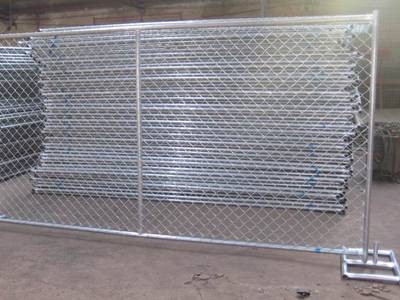
Commercial-grade galvanized chain link fencing engineered for tree protection zones, general perimeter security, and long-duration hoarding applications.
Chain-Link, Solid Panel, or Steel Hoarding: Picking the Right System
The trade-off is dust and privacy versus wind loading and cost.
Chain-Link Temporary Panels
Chain-link temporary panels are the workhorse for suburban and industrial sites where visual containment is not critical. They ventilate, so wind loading is manageable, and installation on concrete or asphalt does not require ground penetration when block bases are used.
Downsides: no dust containment, no privacy, and passersby can reach through if the mesh specification is loose.
Solid Panel Hoarding
Solid panel hoarding, typically 8 foot plywood on steel or timber studs, is standard in dense urban builds where dust control, sightline containment, and signage real estate matter. This is where project graphics, wayfinding, and public notices live.
Engineering note: the wind load calculation is different, and any run longer than roughly six metres needs engineered bracing, especially near tall building corners where uplift becomes an issue.
Steel Hoarding Panels
Steel hoarding panels sit in the middle. Solid enough to contain dust, faster to install than site-built plywood, and reusable across projects. Higher upfront cost, but for a portfolio contractor running consecutive downtown jobs, the amortized cost is often lower.
For access, cantilever and sliding gates outperform swing gates on sites with tight street frontage because they do not consume setback space. Firm Fence Inc supplies swing, sliding, cantilever, and overhead sliding truss gates for perimeter access, plus barrier arms and crash-rated barriers for sites with vehicle screening requirements.
Featured Product: Cantilever and Sliding Gates
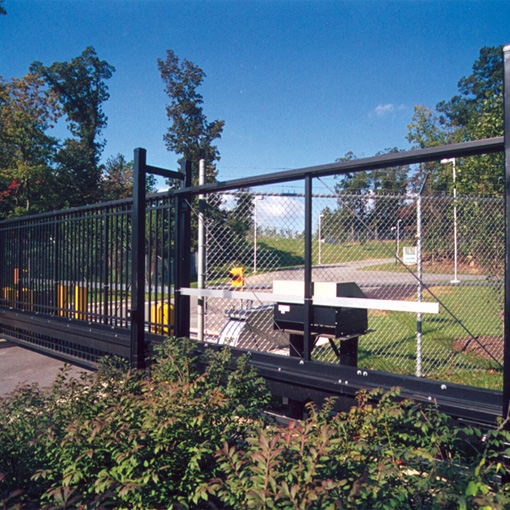
Engineered cantilever and sliding gate systems for vehicle and equipment access on constrained urban frontages — no ground track, no setback consumed.
Featured Product: Crash-Rated Barriers and Barrier Arms
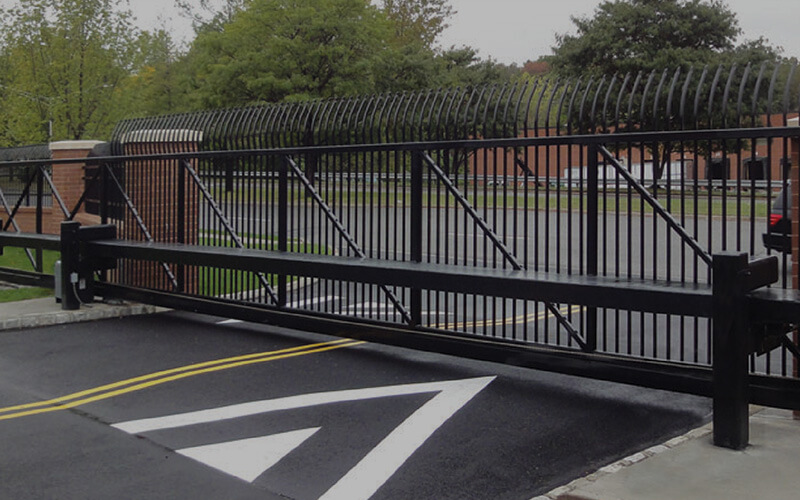
Crash-rated barriers and barrier arms for high-security sites with vehicle screening requirements, from government projects to data centres and utility yards.
The Questions Canadian Homeowners and Small GCs Ask That Nobody Answers Cleanly
A few items that come up in every second consultation but rarely make it into the official guides.
Do I need a permit for hoarding on my own property?
Usually not, if the fence stays inside your property line and does not exceed the residential height limits in your local bylaw. The moment any part of the fence, panel, gate swing, or base plate crosses onto public sidewalk, boulevard, or road allowance, you need a street occupation permit. That includes the block feet on chain-link panels, which is where a lot of people get caught.
Can my hoarding stay up for the whole project?
Yes, but Toronto and most GTA municipalities require it to come down within 30 days of substantial performance or demolition completion. Renewals are possible but require justification and additional fees.
Who is liable if a child climbs the fence and gets hurt?
The constructor. This is not shared or negotiable under OHSA. Your fence has to be sturdy, non-climbable, and continuous. Weekly documented inspections with photographs are your insurance file if something happens.
Does my hoarding need lighting?
If any portion sits within a public right of way and could pose a hazard after dark, yes. Reflective delineators and, on arterial roads, hazard lighting are typically conditions of the street occupation permit.
Can I put advertising on my hoarding?
In Toronto, yes, but the ratio of text to graphic is regulated, and third-party advertising is treated differently than project-related information. Check with Municipal Licensing and Standards before you commit to a wrap. Getting told to strip a printed wrap two weeks after install is an expensive lesson.
Pre-Mobilization Checklist
Before your first shovel breaks ground:
Confirm your bylaw and Construction Hub status
Confirm which municipal bylaw applies and whether you sit inside a designated Construction Hub.
File the street occupation permit early
File the street occupation permit at least 12 weeks before mobilization.
Get the arborist's tree protection plan
Have a certified arborist confirm any TPZ requirements and issue the tree protection fencing plan.
Verify site logistics on the drawing
Confirm gate swing direction, covered walkway width (1.8 m minimum), and bike lane preservation (1.5 m minimum) on the site logistics drawing.
Verify fence material specifications
Verify fence material meets the 1.8 m height, 150 mm opening limit, and non-climbable specification.
Book a supplier who can hit mobilization dates
Book delivery and installation with a supplier who can meet mobilization dates. In the GTA, Firm Fence Inc has been supplying commercial and industrial site perimeter systems since 1979 and services projects across Ontario.
Schedule weekly documented inspections
Schedule weekly documented perimeter inspections for the full duration of the project.
Get the perimeter right and the rest of the site runs on schedule. Get it wrong and you are paying delay claims to your framing crew while an inspector waits for your revised drawings.
Sourcing Hoarding, Gates, or Barriers in Ontario?
If you are sourcing hoarding, gates, or crash-rated barriers for a project in the GTA or anywhere else in Ontario, review the product range at firmfence.com or reach their team through the contact page.
Visit Firm Fence