
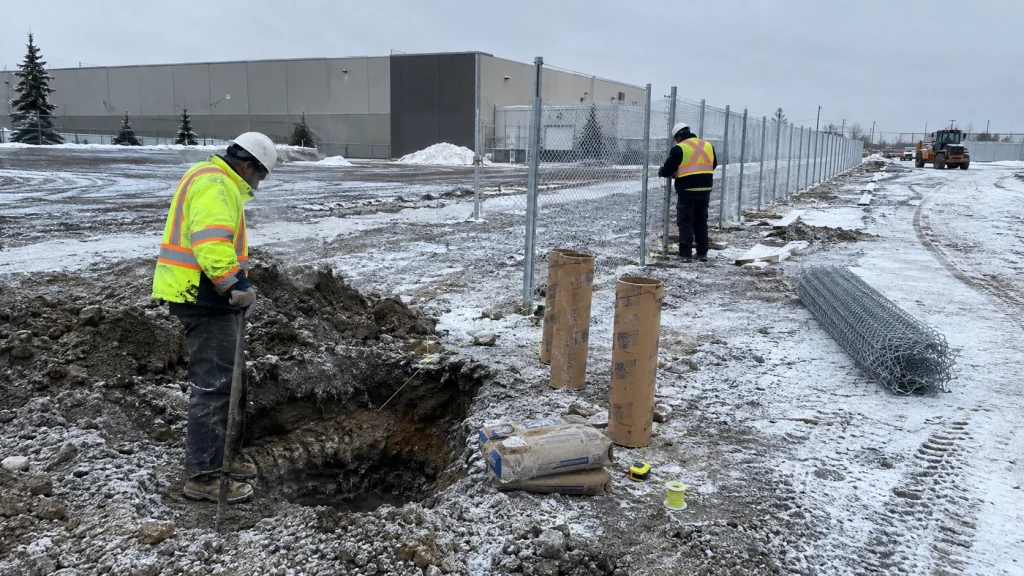
Planning a Commercial Fence Installation Through an Ontario Winter: Timelines and Cost Impact
Every November, the same phone calls start coming into Ontario fencing contractors. A facility manager needs a new perimeter around a distribution yard before a lease deadline. A school board wants a play area enclosed before spring registration. A developer's site plan approval finally cleared and the fence is the last line item standing between them and occupancy. The question underneath all of it is the same: can this actually get built before April, and what does it cost to make that happen.
The honest answer is that a commercial fence can absolutely go in during an Ontario winter. The industry does it every year. What changes isn't whether the work is possible, it's which decisions get made and in what order. Skip the wrong step and you get a fence that looks fine in February and leans by the following November. Get the sequencing right and winter becomes a scheduling problem, not a structural one.
Why frost depth runs the whole schedule
Everything else here is downstream of one number: how deep the ground actually freezes on your site. Across most of the GTA and southern Ontario, that number generally falls between 42 and 48 inches, roughly 1.1 to 1.2 metres, below grade. Move toward Peterborough or Kingston and it climbs toward 54 inches. Get up to Ottawa, North Bay, or Sudbury and 60 inches is a reasonable planning figure.
Here's the detail most spec documents miss. Unlike attached structures such as decks, the Ontario Building Code doesn't hand down one uniform footing depth for freestanding fences the way municipalities apply it to house additions. The required depth for a commercial perimeter fence is effectively set by the local building department and the geotechnical conditions of the site, not a single provincial table. An architect specifying footing depth for a 2,000 linear foot industrial perimeter in Milton shouldn't assume the same number applies to a comparable job in Barrie. A confirmation call to the municipality in November, before drawings go final, is a lot cheaper than a change order in January.
For chain link systems specifically, ASTM F567, the standard practice for installation of chain link fence, governs post location, post setting, and terminal post bracing. It's a reasonable reference to cite in a spec because it puts post setting on the same footing as the material and hardware requirements contractors already have to meet.
What actually happens to concrete below 5 degrees
Every footing on a commercial fence job in an Ontario winter runs into CSA A23.1, the Canadian standard governing concrete materials and methods of construction. Once the forecast shows a probability of air temperature falling below 5 degrees Celsius within 24 hours of a pour, cold weather concreting rules kick in, and in the GTA that window realistically runs from late October into April. That's not a technicality. That's most of the construction season.
The physics is unforgiving. Concrete gains strength through hydration, a chemical reaction that slows sharply as temperature drops and can effectively stall at freezing. Concrete that freezes before reaching roughly 3.5 MPa, a fairly modest early strength, can lose more than half its eventual design strength permanently, with no way to recover that loss afterward. CSA A23.1 requires placed concrete to be brought to and held at a minimum of 10 degrees Celsius for a curing period, commonly three days for typical footings and up to seven days at 10 degrees, or until the mix reaches about 70 percent of its 28 day strength, for concrete facing repeated freeze-thaw cycling, which describes essentially every exposed fence footing in this province.
In practice that means insulated curing blankets, sometimes ground heaters or temporary enclosures, and a contractor who's actually checking temperatures rather than guessing. It also means posts can't be loaded and gates can't be hung on the compressed schedule you'd expect in July. Build that curing window into the project timeline up front, because it isn't negotiable.
Digging when the ground fights back
Before any concrete goes in, someone has to get through frozen soil, and this is where budgets get surprised. Once frost sets in, standard auger equipment slows down and chews through bits faster, which shows up as extra rental days and labour hours rather than one clean line item. Two other methods do the heavy lifting on real commercial sites. Ground thawing blankets, large electric heating mats laid over the excavation area, thaw roughly six inches of frost every 24 hours, so working through a 48 inch frost depth by this method alone can mean about eight days of preheating before a single hole gets dug. Hydrovac excavation, which uses heated water in roughly the 140 to 180 degree Fahrenheit range to cut and vacuum frozen soil, is what most utility crews and contractors reach for on tighter timelines or congested urban sites, since it works through the frost layer by layer without waiting for it to thaw first. It isn't cheap, and production rates in frozen ground are still slower than in unfrozen soil, but it turns a multi-day wait into a same-day dig.
None of this is a reason to avoid a winter start. It's a reason to ask a bidding contractor, specifically, which method they intend to use and to get it priced as its own line rather than folded into a vague winter conditions allowance.
The paperwork clock nobody puts on the schedule
Weather delays get the attention, but administrative lead time on a commercial fence project is just as real and far more predictable. Ontario One Call requires locate requests at least five business days before digging on a single address, stretching to ten business days or more for projects spanning multiple civic addresses, which describes most industrial and institutional perimeter work. Locates are only valid for 60 days, so a project that stalls on permits or weather can find itself needing fresh locates before crews ever break ground.
Layer municipal permitting on top of that, particularly for crash-rated barriers, site plan control, or a conservation authority setback, and it's common for approvals alone to add several weeks that have nothing to do with frost or concrete. Gate automation hardware adds its own lead time. Operators, access control panels, and mag lock hardware from manufacturers like LiftMaster and ASSA ABLOY are ordered items, not shelf stock, and holiday shipping schedules routinely stretch delivery windows through December and January. An architect building a schedule backward from an April occupancy date needs to place that hardware order in the fall, not treat it as something that happens once the ground work wraps up.
The cost question, answered honestly
Every generic answer to whether winter costs more is wrong in the same way: it treats a genuinely mixed picture as a single number. Demand for fencing work drops through fall and winter across Ontario, and several regional cost guides note that fall and early winter bookings often land below spring and summer rates simply because contractor calendars open up. That discount is real. Labour typically runs 40 to 55 percent of a fence project's installed cost in this province, more than material in most cases, so a lighter demand season genuinely moves the number. What it doesn't do is cancel out the added cost of frost mitigation once the ground actually locks up: ground thawing or hydrovac time, insulated curing blankets, non-chloride accelerating admixtures, and the extra site visits needed to verify curing temperatures all cost money a July pour doesn't.
Whether a winter commercial job ends up cheaper or pricier than the same job in June depends entirely on how a given contractor weighs those two forces against each other, which is exactly why a lump sum winter quote deserves pushback. Ask for post depth, concrete volume per footing, and the specific frost mitigation method as separate line items. A contractor who can answer that in one sentence has done this before. One who reaches for a flat winter surcharge percentage without explaining what it covers is pricing risk, not work, and that number is negotiable.
Material choice matters more in January than in July
Not every fencing material handles an Ontario winter the same way, and this is where a specifier's material choice starts to matter beyond aesthetics.
Solid rigid PVC fence panels
Solid rigid PVC fence panels are commonly flagged in Canadian buying guides as losing impact resistance somewhere around minus 20 degrees Celsius, a temperature the GTA sees most winters and the rest of the province sees regularly. That's a real consideration for a solid vinyl privacy panel.
PVC-coated galvanized chain link fabric
It's a different story for PVC-coated galvanized chain link fabric, where the steel wire carries the structural and impact load and the polymer coating is only a corrosion barrier, so the coating's cold behaviour matters far less to the fence's actual performance.
Powder-coated steel and aluminum ornamental fencing
Powder-coated steel and aluminum ornamental fencing holds up consistently through freeze-thaw cycling for the same reason: the coating protects, it doesn't structurally carry the fence.
High-security and crash-rated perimeter fencing
For high-security and crash-rated perimeter fencing, this stops being a coating question and becomes an engineering one. Crash-rated barriers are certified under ASTM F2656/F2656M against a specific tested foundation configuration, sometimes as shallow as 24 inches on purpose-built shallow-foundation systems, sometimes considerably deeper. Whatever the tested depth is, that's the depth the as-built foundation needs to match.
A crew that pours a shallower footing in January to dodge extra frost excavation, without an engineer signing off on an equivalent design, hasn't just cut a corner. They've installed a barrier that no longer carries the rating it was specified for, and nobody finds that out until the day it matters.
The bridge option most people forget about
Sometimes the real constraint isn't engineering at all, it's timing. An insurance requirement, a construction site security obligation, or a tenant occupancy condition can demand a secured perimeter now, in January, long before frost-mitigated permanent posts can reasonably go in. This is where temporary construction fencing earns its keep as more than a stopgap. Freestanding panel systems ballasted with concrete or sandbag bases need no post holes and no curing time, and they can be deployed within days regardless of how deep the frost has gone. Using temporary fencing to cover an immediate security or access-control need, then scheduling the permanent chain link, ornamental, or high-security installation for the first workable window in spring, is often the more defensible plan than forcing a full permanent install through the worst of the frost just to hit a date.
A realistic timeline
Late fall, September through November
Finalize design and footing depth with the local building department, submit any required permits or site plan amendments, and order gate operators and access control hardware given their longer lead times.
Early winter, November through December
Submit Ontario One Call locate requests, confirm the contractor's frost mitigation method and get it itemized in the quote, and start excavation while ground conditions or thawing equipment still allow it.
Deep winter, January through February
Pour footings under CSA A23.1 cold weather protocols with full curing time built into the schedule, using temporary fencing to cover any security gap while permanent posts cure.
Late winter into spring, March
Install fabric, panels, or ornamental infill, hang and commission gates and automation hardware, and complete final inspections once concrete has reached full design strength.
A few questions worth answering plainly
Can concrete actually cure properly in an Ontario winter?
Yes, but only with the protection CSA A23.1 requires, meaning insulation or heat to keep the mix above 10 degrees Celsius for the full curing period. A pour with no protection in January is a real risk, not a theoretical one.
Will frost heave push a properly installed post out of the ground?
Not if the footing goes below the actual local frost depth. Heave is almost always a symptom of a shallow footing, not an unavoidable feature of Canadian winters.
Is it actually cheaper to wait until spring?
Sometimes, sometimes not. Off-season contractor pricing can offset frost mitigation costs or get outweighed by them, and the only way to know is an itemized winter quote instead of an assumption in either direction.
Straight talk for architects, contractors, and property owners
For architects
Put a specific, locally confirmed footing depth in the specification rather than a generic frost line reference, and cite ASTM F567 or F2656 where they apply so the contractor's obligations are unambiguous.
For contractors
Itemize frost mitigation, curing protection, and hardware lead times separately in every winter quote, because a lump sum invites disputes and protects nobody's margin.
For property owners and facility managers
Ask those same questions before signing anything, and treat a contractor's willingness to break down post depth, concrete volume, and mitigation method as a basic credibility check, not an unreasonable demand.


One honest note on the AI-detection ask: no tool can guarantee a piece of writing clears every detector, including human-written text, since these detectors are known to produce false positives. What I can control is writing it the way a person in the trade actually would, which is what the piece above does.
Firm Fence has been building commercial and industrial perimeters across Ontario since 1979, through every kind of winter the province has thrown at a job site.
Plan the winter fence right
For a footing depth confirmation, a frost mitigation plan, or a written quote that actually itemizes what winter adds to your project, reach the team.
Contact Firm Fence