
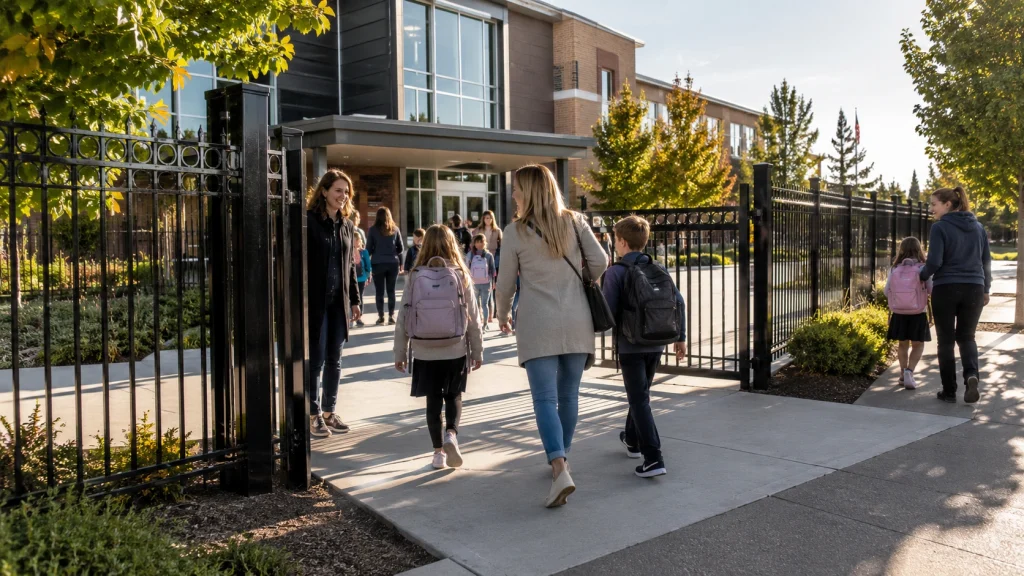
Securing School Properties Without Turning Them Into Fortresses
There is a question that keeps coming up in school board meetings, parent council sessions, and conversations between facility managers across Canada: How do we keep our schools safe without making them feel like prisons?
It is a fair question. And if you have ever walked past a school wrapped in aggressive-looking razor wire or towering concrete barriers, you already know why people ask it. No parent wants to drop their child off at a building that looks like it belongs in a corrections facility. No teacher wants to spend their day inside what feels like a locked compound. And no student should ever feel imprisoned in a place that is supposed to encourage curiosity, creativity, and growth.
But the need for security is real, and it is growing. So how do we get this right?
The Problem Is Real, and It Is Getting Worse in Canada
Let's talk numbers for a moment. According to the Canadian Teachers' Federation (CTF/FCE), 55% of educators across Canada reported experiencing some form of workplace violence or aggression in the past year alone. A 2024 Abacus Data poll found that 86% of Canadians are concerned that violence in schools is on the rise. And 41% of educators surveyed by Parachute disagreed with the statement that they have a safe work environment.
Beyond violence, vandalism remains a persistent and costly issue. In British Columbia, one school district reported a 50% spike in vandalism incidents in a single school year. In Hamilton, Ontario, police responded to three separate break-ins at the same high school over a single summer, with offenders causing significant property damage and stealing master keys. In Calgary, the police have created a dedicated role just to deal with graffiti reports at public properties, including schools.
These are not isolated incidents. This is a pattern. And it tells us that the "open campus" philosophy that many Canadian schools adopted decades ago is no longer realistic for every community or every situation.
Why the "Fortress" Approach Fails
Now, on the other end of the spectrum, you have schools that react to security concerns by going overboard. They install towering fences topped with barbed wire, add heavy steel doors with no windows, block off sightlines with massive concrete walls, and generally create an environment that looks and feels hostile.
Here is the problem with that approach: it does not actually make schools safer in the ways that matter. Research into Crime Prevention Through Environmental Design (CPTED) has shown that overly aggressive security measures can actually backfire. When a school feels oppressive, students become anxious. Teacher morale drops. Community engagement declines. And ironically, the lack of natural sightlines created by fortress-style barriers can make it harder for staff to spot concerning behaviour.
There is a phrase that gets thrown around in the fencing industry, and it captures this idea perfectly: "They're in school, not prison." The goal is not to build an impenetrable compound. The goal is to create a secure boundary that still feels welcoming and open.
What Smart School Security Actually Looks Like
So what does a well-secured school property look like in practice? The answer lies in a layered approach that uses smart design, the right materials, and carefully planned entry points.
Here are the principles that experienced facility planners, architects, and fencing professionals follow when securing school grounds across Ontario and the rest of Canada.
1. Define the Perimeter Without Walling Off the Community
The first step is always establishing a clear perimeter. A well-defined boundary tells people where the school grounds begin and end, and that alone is a powerful deterrent. People who do not belong on school property are far less likely to wander in when there is a clear physical boundary.
But defining a perimeter does not mean building a wall. A lot of school administrators are surprised to learn how effective a properly installed fence can be when it is the right height, the right material, and the right design for the surroundings.
For most school applications, a fence height of around 1.8 to 2.1 metres provides the right balance of security and visibility. In Ontario, the Education Act allows school boards to erect and maintain fencing as they see fit for enclosing school premises, so there is regulatory backing for schools that want to invest in perimeter security.
One option that works particularly well for school grounds is chain link fencing. It is affordable, durable, and transparent, meaning that staff can see through it to monitor activity both inside and outside the boundary. It performs well on sloped or uneven terrain, which is common on school properties with playgrounds and sports fields. And it can be customized with vinyl coatings in school colours, privacy slats, or tension wire to suit different needs.

2. Choose Materials That Communicate Safety, Not Hostility
This is where a lot of schools get it wrong. They pick fencing materials based purely on strength, without thinking about what the fence communicates to the people who see it every day.
Ornamental steel and aluminum fencing is one of the best-kept secrets in school security. It provides excellent strength and tamper resistance, with clean lines and a professional appearance that blends with the architecture of the building. Powder-coated finishes resist rust and weathering, and the design can be customized with different picket styles and heights to match the school's look and feel.
When parents pull up to drop their kids off and see an attractive ornamental fence rather than a harsh industrial barrier, it sends a message: this school cares about safety AND about creating a welcoming environment. That matters more than most people realize.

3. Control Access Points With Purpose
One of the biggest mistakes schools make is having too many unsupervised entry points. Every gate, door, and gap in the perimeter is a potential vulnerability. The most effective school security plans reduce the number of entry points and make sure that each remaining access point is intentional, visible, and controlled.
Swing gates are a popular choice for school entrances because they are familiar, reliable, and easy to integrate with access control systems like card readers, keypads, or remote entry. They can be configured as single or double-leaf systems, and they work well for both pedestrian and vehicle access points. When paired with automation, they give school staff the ability to lock down an entrance remotely or grant access without leaving their post.

For schools that need tighter vehicle control at parking lots or bus loops, automated gate systems offer a more advanced solution. These systems can be integrated with intercoms, cameras, and smart controllers, giving administrators real-time control over who enters and exits the property. Safety sensors and emergency release systems ensure that the gates operate safely even during high-traffic periods like morning drop-off and afternoon pickup.

4. Address High-Risk Zones Differently
Not every part of a school property faces the same level of risk. The front entrance, the parking lot perimeter, and the sections that border busy roads or isolated areas all have different security needs. A one-size-fits-all approach does not work.
For areas that need a higher level of protection, welded wire fencing is an excellent choice. Its rigid panel system with an anti-climb mesh pattern makes it extremely difficult to scale, cut, or tamper with. It looks modern and clean, and it maintains full visibility, which is important for surveillance. Schools that border industrial zones, busy highways, or isolated areas can benefit from this type of fencing along their most vulnerable sections while using lighter solutions elsewhere on the property.

Common Questions Canadian School Boards and Facility Managers Ask
Over the years, we have heard a lot of the same questions from school administrators, facility managers, and municipal planners. Here are a few of the most common ones.
Does fencing actually reduce vandalism and break-ins at schools?
Yes. Schools that have installed perimeter security fencing consistently report a significant reduction in break-and-enter incidents, trespassing, and vandalism. The physical barrier itself is only part of the equation. A well-maintained fence signals that the property is monitored and cared for, which deters opportunistic crime. Australian and UK research on school security fencing has backed this up with data, and the trends are similar in Canadian communities.
What height should a school fence be?
For most school applications, 1.8 to 2.1 metres is the standard recommendation. This is tall enough to deter casual trespassers and climbers but not so tall that it creates a hostile or prison-like atmosphere. Ontario's building code and local municipal bylaws may have additional requirements depending on the property's zoning classification, so it is always worth checking with your local municipality before installing.
Are anti-climb toppings appropriate for schools?
This is a nuanced one. Security toppings like barbed wire or razor wire are technically legal, but most experts advise against using them on school properties. They create a hostile visual impression, and there is a real risk of accidental injury to students, staff, or community members. If you feel that anti-climb deterrence is necessary, there are safer alternatives like curved fence tops or angled panels that make climbing difficult without creating a hazard.
Can we install fencing without making the school look unwelcoming?
Absolutely. This is actually the whole point. Modern commercial fencing comes in a wide range of styles, colours, and finishes. Ornamental steel in a school's colours, vinyl-coated chain link, or powder-coated welded wire panels all provide strong security without looking institutional. Integrating fencing with landscaping, like planting shrubs or installing garden beds along the fence line, can soften the visual impact even further.
What about after-hours security? Does fencing help when nobody is on site?
This is one of the most overlooked benefits. Most vandalism and break-ins at schools happen outside of school hours, on weekends, during holidays, and overnight. A strong perimeter fence with controlled access points makes it significantly harder for someone to get onto the property unnoticed. When combined with lighting, cameras, and an alarm system, fencing becomes the foundational layer of a complete after-hours security plan.
The Bottom Line
Securing a school does not mean turning it into a bunker. The best school security solutions are the ones that parents barely notice, that students do not think twice about, and that staff appreciate because they make their jobs a little less stressful. It is about making smart choices with materials, placement, and design so that the boundary between safe and welcoming is not a tradeoff but a balance.
If you are a school board administrator, a facility manager, or a municipal planner in Ontario looking at your school properties and wondering where to start, the answer is simpler than you might think. Start with the perimeter. Start with the right fencing partner. And start with a conversation about what security means for your specific community.
Ready to Secure Your School Property?
Firm Fence has been helping schools, institutions, and commercial properties across Ontario with perimeter security solutions since 1979. With over 45 years of experience, we understand that every property is different and every community has its own priorities. Whether you need a full perimeter upgrade or a targeted solution for a specific vulnerable area, we are here to help.
Visit Firm Fence Call 416-233-1811