
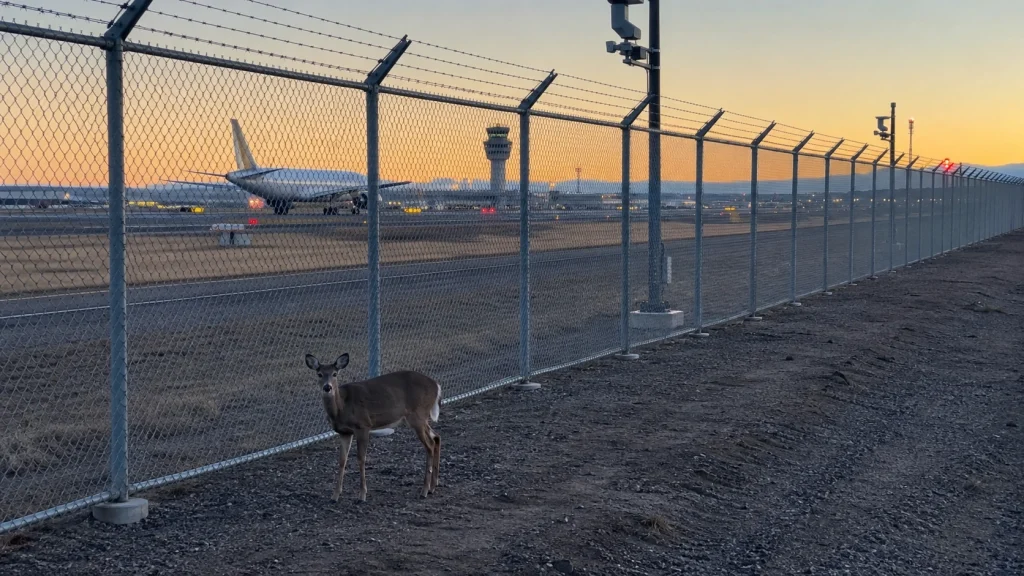
Airport Perimeter Fencing: Security Clearance, Wildlife Exclusion, and Site Safety Requirements
If you have ever driven past Pearson International or flown out of a smaller regional airport somewhere in Northern Ontario, you have probably noticed the tall chain link fence running along the edge of the property. Maybe you glanced at it for a second and moved on. Most people do. But that fence is doing a lot more work than you might think, and the rules behind it are far more complex than "put up a fence and call it a day."
Airport perimeter fencing in Canada sits at a unique crossroads. It has to satisfy Transport Canada's aviation security regulations, keep wildlife off active runways, hold up against some of the harshest weather conditions in North America, and still allow for the kind of visibility that security patrols and surveillance cameras depend on. Getting any one of those wrong can ground flights, endanger passengers, or result in costly regulatory violations.
So whether you are an airport operator, a general contractor bidding on an airfield project, or a facility manager trying to understand what your obligations actually look like, this guide breaks down what goes into airport perimeter fencing across Canada and why it matters so much more than people realize.
Why Airport Fencing Is Not Just Another Fence
A lot of people assume that airport fencing is basically the same as what you would see around a warehouse or a construction site, just taller. That is not the case at all. Airport fencing operates under a completely different set of performance requirements.
Transport Canada's Canadian Aviation Regulations (CARs), Part III, Subpart 2, lays out the standards for certified airports in this country. Under these rules, airports must maintain a secure perimeter that prevents unauthorized access to restricted areas including runways, taxiways, and aprons. The fence itself is considered the first physical line of defence between the public side (landside) and the restricted operational side (airside).
At major Canadian airports like Vancouver International (YVR), for example, there are strict clear zone requirements around any fence line displaying "Restricted Area" signage. YVR requires a 3-metre clear zone on the exterior and a 1-metre clear zone on the interior of every such fence. These buffer zones ensure that vegetation, equipment, and debris cannot be used to climb over or compromise the barrier.
Most airport perimeter fences in Canada stand at a minimum of 8 feet, though many installations go to 10 or even 12 feet depending on the threat assessment for that particular site. On top of that, you will usually see barbed wire, razor ribbon, or some type of anti-climb topping angled toward the airside. The idea is to make it extremely difficult for anyone to scale the fence, and to make any attempt very visible on security cameras.
For airports that need the highest level of perimeter protection, products like High-Security & Crash-Rated Fencing are built specifically for this purpose. These systems use reinforced steel and crash-tested components designed to stop vehicle intrusion and forced entry attempts, and they meet or exceed ASTM and government impact standards.

The Wildlife Problem Nobody Talks About Enough
Here is something that surprises a lot of people: one of the biggest reasons Canadian airports need serious perimeter fencing has nothing to do with human intruders. It is the wildlife.
Canada is home to large populations of white-tailed deer, coyotes, Canada geese, snow geese, and dozens of other species that are naturally drawn to airport environments. The flat, open grasslands around runways look like ideal habitat to these animals. And when a 150-pound deer wanders onto an active runway at the same time a regional jet is rolling at 130 knots, the results can be catastrophic.
Transport Canada introduced wildlife planning and management regulations under CARs in 2005 specifically because the problem was getting worse. Populations of hazardous species like deer, coyotes, gulls, and large raptors were increasing, and many of these animals are what biologists call "urban-tolerant," meaning they have adapted to living in close proximity to human activity, airports included.
Under these regulations, every certified airport in Canada must file a Wildlife Management Plan with Transport Canada. Part of that plan involves fencing. Airports are expected to install and maintain perimeter fencing that can physically exclude large mammals, particularly deer and coyotes, from airside areas. In fact, Transport Canada's Standard 322 specifically references documents on deer exclusion fencing as required guidance for airport operators developing their wildlife management plans.
The Government of Canada has put real money behind this issue as well. Back in 2014, the Airports Capital Assistance Program (ACAP) invested over $920,000 at the Dryden Regional Airport in Ontario specifically for wildlife management fencing to keep deer and bears off the runway.
For wildlife exclusion applications at airports, Animal Protection & Agricultural Fencing provides a strong solution. These fencing systems use heavy-duty, rust-resistant mesh construction with customizable heights and opening sizes designed to safely deter and exclude animals without causing harm. While they were originally developed for farms, conservation areas, and highway corridors, the same engineering principles apply directly to airport wildlife exclusion zones.

What Kind of Fencing Actually Works at Airports?
This is one of the most common questions we hear, and the answer depends on the specific requirements of the airport and its location.
Chain Link Fencing
Chain link fencing remains the most widely used option for airport perimeters across Canada and around the world. Its diamond-shaped woven mesh offers a good balance between strength, visibility, and cost. Security patrols need to be able to see through the fence to spot potential threats, and surveillance cameras need clear sightlines. Chain link delivers on both fronts. When topped with barbed wire or razor ribbon and combined with a buried bottom rail to prevent animals from digging underneath, it becomes a very effective all-around airport barrier.
Chain Link Fencing from Firm Fence is available in galvanized or vinyl-coated finishes and can be configured with barbed wire, privacy slats, or tension wire depending on the security profile required. It also performs well on varied or sloped terrain, which is important because airport perimeters often cover large stretches of uneven ground.

Welded Wire Fencing
Welded wire fencing is becoming increasingly popular for airport applications where a higher security standard is needed. Unlike traditional chain link, welded wire panels are rigid and feature an anti-climb mesh pattern that makes them extremely difficult to scale or cut through. They also offer a cleaner, more modern architectural appearance, which matters to airports that want their perimeter to look professional as well as secure.
Welded Wire Fencing is specifically listed for airport and secure facility applications. Its rigid panel system provides high strength and resistance to cutting while maintaining full visibility for surveillance systems.

Access Points: Gates and Barriers That Keep Things Moving
A fence is only as secure as its weakest point, and at an airport, those weak points are almost always the gates. Airports have dozens of access points for vehicles, maintenance crews, catering trucks, fuel tankers, emergency responders, and cargo handlers. Every single one of those openings needs to be controlled, monitored, and secured.
This is where automated gate systems and barrier arms come in.
Automated Gate Systems
Automated Gate Systems combine functionality and security by integrating with remote controls, keypads, RFID readers, intercoms, cameras, and smart controllers. For airport environments where gates open and close hundreds of times a day, heavy-duty motors rated for high-cycle use are essential. These systems can be applied to swing gates, sliding gates, or cantilever gates depending on the site layout.

Barrier Arms (Traffic Barriers)
For vehicle checkpoints and parking areas, Barrier Arms (Traffic Barriers) provide efficient access control with quick operation designed for high-traffic environments. They integrate with RFID readers, keypads, and ticket dispensers, and they are available in standard, heavy-duty, and crash-rated versions with optional LED lights and reflective strips for visibility. At Canadian airports where winter darkness stretches well into the morning and evening hours, that visibility is not optional.

Crash-Rated Barriers
And at the highest-security access points, such as entrances to fuel storage areas, control tower compounds, or restricted maintenance zones, Crash-Rated Barriers provide the ultimate line of defence. These are engineered and certified to K4 through K12 (or M30 through M50) crash ratings, meaning they can stop a vehicle travelling at highway speeds. They are available as bollards, wedge barriers, or beam gates and integrate directly with automation and access control systems.

Questions Canadian Airport Operators and Contractors Commonly Ask
Does airport fencing need to be non-metallic near radar installations?
In some cases, yes. Radar and navigational equipment at airports can be affected by large metallic structures in close proximity. Some airports have installed non-metallic or low-conductivity fencing in specific areas near radar installations to avoid interference. This is something that needs to be evaluated on a site-by-site basis during the design phase. Custom fabrication is often required for these sections.
Who is responsible for fence inspections at a Canadian airport?
Under Transport Canada regulations, the airport operator is responsible for maintaining the perimeter fence in good condition and conducting regular inspections. Any damaged fencing, broken gates, or compromised access points must be reported and repaired promptly. Many airports conduct daily perimeter inspections as part of their security programs.
Can the same fence serve both security and wildlife exclusion purposes?
Absolutely, and in fact that is the goal at most Canadian airports. A well-designed perimeter fence should prevent both unauthorized human access and wildlife intrusion. This often means using a fence tall enough to deter climbing (8 feet minimum, often 10 to 12), with a buried bottom rail or mesh apron to prevent animals from digging under, and anti-climb topping to address the human intrusion side.
What about construction zones near active runways?
Temporary fencing during construction on or near airport property must still comply with Transport Canada safety requirements. Construction zones adjacent to runways and taxiways need to be clearly marked and secured, and temporary fencing must not interfere with the overall perimeter security of the airport. Temporary & Construction Fencing solutions are available for exactly these kinds of projects.
How does extreme Canadian weather affect airport fencing?
This is a big one that does not get discussed enough. Heavy snow accumulation can compromise the bottom section of a fence, create drift-based ramps that animals can walk over, or short out electric fence components. Ice storms can damage fence fabric and posts. Airport operators in Ontario and across Northern Canada need fencing materials that are galvanized, corrosion-resistant, and rated for extreme temperature swings. Maintenance schedules need to account for seasonal challenges, including snow removal along fence lines and post-storm inspections.
Why Getting This Right Matters
Airport perimeter fencing is not a commodity purchase. It is a regulated, safety-critical system that directly affects the security of passengers, the safety of flight operations, and the operational compliance of the airport itself. Cutting corners on materials, installation, or design is not just a bad business decision. It is a risk that can have serious consequences.
If you are involved in an airport fencing project anywhere in Ontario or across Canada, working with a contractor that understands the full scope of these requirements makes all the difference. Firm Fence has been providing commercial and industrial fencing solutions since 1979, with experience across high-security facilities, transit infrastructure, and large-scale institutional projects.
From chain link perimeters to crash-rated barriers and everything in between, the team at Firm Fence can help you design, supply, and install a perimeter system that meets Transport Canada regulations, handles wildlife exclusion, and stands up to whatever the Canadian climate throws at it.
Start Your Airport Fencing Project
Get in touch with our team to discuss your specific security, wildlife exclusion, and site safety requirements.
Contact Firm Fence