
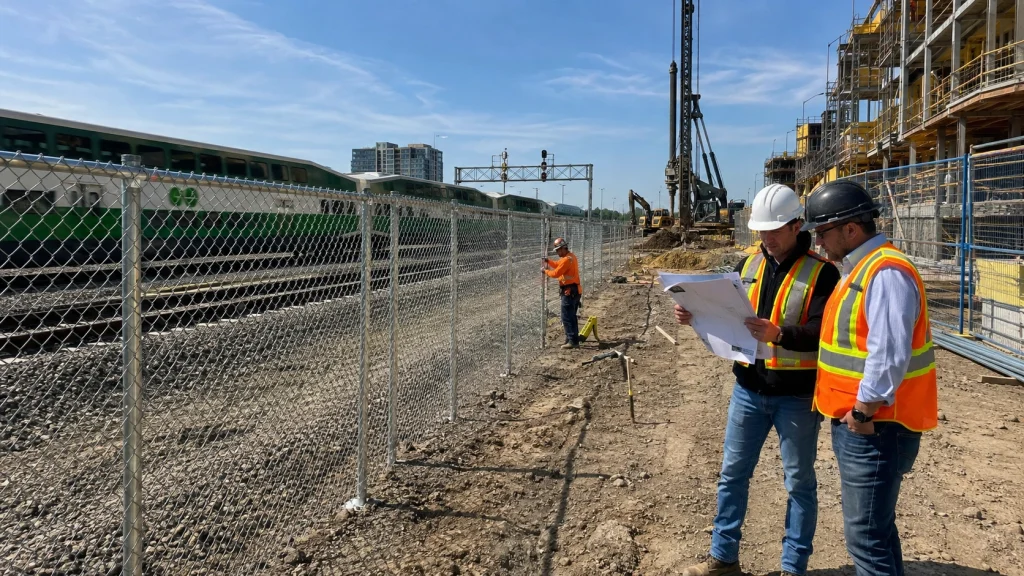
Fencing Near Metrolinx GO and LRT Corridors: What GTA Developers and Contractors Need to Know
If you are a developer, general contractor, or project manager working anywhere in the Greater Toronto Area, there is a very good chance your next project will sit within spitting distance of a Metrolinx rail corridor.
That is not an exaggeration. Between the GO Transit network, the newly opened Eglinton Crosstown and Finch West LRT lines, the Hazel McCallion LRT under construction in Mississauga, the Ontario Line, and the various subway extensions underway, Metrolinx is building or operating over 200 kilometres of rail across the region. And all of that track needs to be fenced.
But here is the thing nobody tells you upfront: the fencing rules near these corridors are not the same as a regular commercial or industrial job. There are specific standards, setback requirements, permit processes, and material specs you need to follow. Getting them wrong can delay your project by weeks, cost you tens of thousands of dollars in rework, and in extreme cases, land you with fines up to $500,000 under the Building Transit Faster Act.
So let us break it down.
What Counts as "Near" a Metrolinx Corridor?
This is the first question most people ask, and the answer depends on which type of corridor you are dealing with.
GO Transit Corridors
For GO Transit heavy rail corridors, Metrolinx reviews any development proposal on lands within 300 metres of their right-of-way. That is a wide net. It covers everything from condo towers to warehouse expansions to new hospital wings.
LRT Corridors
For LRT corridors like the Eglinton Crosstown, Finch West, and the Hazel McCallion Line, the review zone is tighter but still significant. Any project next to or within 60 metres of an LRT corridor triggers the Metrolinx adjacent development review process.
Priority Transit Projects
And for Priority Transit Projects like the Ontario Line and the various subway extensions, the Province has designated Transit Corridor Lands with formal buffer zones. You need a Corridor Development Permit (CDP) for any building or road work within 30 metres of those lands, and for utility work within 10 metres.
The bottom line: if your site is anywhere near rail infrastructure in the GTA, you should be checking with Metrolinx before you finalize your fencing plan.
What Are the Actual Fencing Requirements?
Metrolinx published a formal standard called "Fencing and Anti-Trespassing Requirements (RC-0401-06)" that lays out exactly what they expect. Here are the key takeaways that matter for contractors and developers.
Height
High-security fencing along Metrolinx corridors must be 2.4 metres (roughly 8 feet) tall. In certain areas, the minimum fence height has to be at least 1 metre above top of rail, which can mean even taller installations depending on the grade.
Materials
Metrolinx commonly specifies galvanized chain link fencing as the baseline, but in areas with higher trespassing risk, they escalate to high-security panels. That includes welded wire mesh, anti-climb designs, and in some locations, expanded metal grating. The fencing standard also calls for galvanized steel pipe frames and braces for all gates.
Gates
Gates are a whole separate conversation. Metrolinx requires specific gate configurations including double sliding gates in both chain link and high-security formats, with openings up to 9 metres wide. All access gates need high-security locks (Abloy-type systems are called out in the standard), anti-trespass signage, and Tow Away Zone signs where directed.
Private Fencing and Property Lines
Private fencing, meaning the fence that a developer installs on their own property adjacent to the corridor, has to sit at least 4 inches from the property line. This ensures all the fencing materials remain entirely on private land and do not encroach on the Metrolinx right-of-way.
Vegetation Management
One detail that catches a lot of people off guard: if your fence is offset from the property line, you may need to submit a Vegetation Management and Graffiti Removal Plan to the Metrolinx Corridor Maintenance Office. That strip between your fence and the property line needs to stay clear of overgrowth and vandalism, and Metrolinx wants to see your plan for keeping it that way.
The Setback and Safety Barrier Rules That Nobody Talks About
Here is where it gets complicated, and where most online resources fall short.
For "Sensitive Uses" (which includes residential, commercial, industrial, institutional buildings, and even programmed open space), Metrolinx follows established industry practice that calls for a 30-metre setback combined with a 2.5-metre-high earthen berm as the standard mitigation measure. If your project cannot achieve this full setback, you will need to submit a Rail Safety and Risk Mitigation Report. This report has to demonstrate that your proposed safety measures offer a level of protection equivalent to or better than the standard setup.
What does this mean for fencing? In many cases, when the full 30-metre setback is not feasible (and in the GTA, let's be honest, it often isn't), fencing becomes a critical component of your alternative safety strategy. The type, height, and configuration of your perimeter fencing directly influences whether Metrolinx will approve your development proposal. This is not just about keeping people out. It is about proving that your site can coexist safely next to active rail operations.
Which Fencing Products Actually Work for These Projects?
After dealing with Metrolinx requirements and understanding the standards, the next question is always practical: what do I actually install?
Chain Link Fencing
For perimeter fencing along GO and LRT corridors, chain link fencing remains the workhorse solution. It offers the right combination of strength, visibility, and cost-effectiveness for long corridor runs. Galvanized or vinyl-coated finishes both meet the durability requirements, and you can add barbed wire, privacy slats, or tension wire based on the security level your project needs. View chain link fencing options.
Welded Wire Fencing
For higher-risk areas where Metrolinx flags increased trespassing probability, you will need to step up to something more robust. Welded wire fencing is an excellent option here. Its rigid panel system with anti-climb mesh patterns makes it significantly harder to scale or cut compared to standard chain link. The clean, modern look also helps when your project has an aesthetic component, which is increasingly common on mixed-use developments near transit stations. View welded wire fencing options.
High-Security and Crash-Rated Fencing
For the most sensitive locations, including areas near stations, grade crossings, or spots with documented trespassing history, high-security and crash-rated fencing is the way to go. These systems use reinforced steel panels and are engineered to withstand forced entry attempts and even vehicle impact. They meet or exceed ASTM standards, and they integrate well with electronic access control systems when the project calls for it. View high-security and crash-rated fencing.
Sliding Gates
Gates deserve special attention on corridor-adjacent projects. Metrolinx specifically calls for sliding gate configurations in their fencing standard, and for good reason. Sliding gates handle large openings efficiently without needing the swing clearance that other gate types require. When your site boundary runs tight against a rail corridor, that space savings is critical. View sliding gate options.
Automated Gate Systems
And if your project involves any kind of ongoing vehicle access, automated gate systems with safety sensors are practically a necessity. They keep traffic moving while maintaining the security perimeter that Metrolinx expects. View automated gate systems.
Construction Phase Fencing: A Step People Skip at Their Own Risk
Here is another gap in the conversation. Most discussions about Metrolinx fencing focus on the permanent installation, the fence that will stand for the life of the building. But the construction phase has its own fencing requirements, and they are just as strictly enforced.
During any construction activity near a Metrolinx corridor, you need temporary fencing in place before work begins. Metrolinx's own documentation states that during the installation of new permanent fencing, contractors must ensure that temporary fencing and other safety measures are in place throughout the process. There is no grace period. There is no "we will put it up next week." The corridor has to be secured at all times.
Temporary and Construction Fencing
Temporary and construction fencing is designed for exactly this scenario. Freestanding panels with concrete or sandbag bases go up fast, relocate easily as the project evolves, and come down without leaving permanent marks on the site. You can add privacy screens for dust and debris control, which also helps with community relations when you are working next to an active transit stop. View temporary and construction fencing.


Common Questions That Nobody Seems to Answer
After working with contractors and developers on transit-adjacent projects, a few questions come up over and over again. Here are some honest answers.
Do I really need Metrolinx approval for my fence, or can I just put it up?
You need approval. Even if your fence sits entirely on your own property, Metrolinx reviews fencing plans as part of the adjacent development process. Skipping this step can result in a stop-work order.
Who pays for the fencing along the corridor boundary?
Generally, the developer or property owner is responsible for installing and maintaining private fencing along the shared boundary. Metrolinx maintains fencing on their own property, but if your development triggers the need for upgraded fencing, that cost falls on you.
Can I use any fencing contractor, or does Metrolinx have an approved list?
Metrolinx does not publish a formal approved contractor list for private fencing, but the work needs to meet their published standards. Working with a contractor that has experience on commercial and industrial projects near rail corridors makes a significant difference in how smoothly the approval process goes. A company like Firm Fence, which has been specializing in commercial and industrial fencing across Ontario since 1979, understands these standards inside and out.
What happens if my fence gets damaged by rail operations, vibration, or weather?
You are responsible for maintaining your private fencing in good condition. Metrolinx expects ongoing upkeep, and if your fence degrades to the point where it no longer meets the standard, you will hear about it.
What about the new LRT lines? Are the fencing rules different from GO corridors?
The core principles are the same (keep people off the tracks, maintain security, follow the engineering standards), but the specific review processes differ. GO corridors fall under the Adjacent Development Guidelines, while LRT and Priority Transit Projects involve the Operational LRT Technical Review Guide and the Corridor Development Permit process respectively. The requirements may also vary depending on whether the LRT runs at grade, in a tunnel, or on elevated track.
Why This Matters Right Now
The GTA is in the middle of the largest transit expansion in Canadian history. The Eglinton Crosstown opened in early 2026. The Finch West LRT launched in December 2025. The Hazel McCallion Line is under construction in Mississauga. The Ontario Line, the Scarborough Subway Extension, the Eglinton Crosstown West Extension, and the Yonge North Subway Extension are all moving forward.
Every one of these projects creates new corridor boundaries where fencing is required. And every piece of land adjacent to these corridors now falls under Metrolinx review jurisdiction. If you are developing, building, or renovating anywhere near transit infrastructure in the GTA, fencing is not an afterthought. It is a core project requirement with real regulatory teeth behind it.
Getting it right from the start, choosing the correct products, working with experienced contractors, and engaging with Metrolinx early in the design process, saves you time, money, and a lot of headaches down the road.
Why Work With Firm Fence
Since 1979, Firm Fence has specialized in commercial and industrial fencing projects across Ontario, including work along active rail corridors where Metrolinx compliance is non-negotiable.
Get Expert Guidance on Metrolinx-Compliant Fencing
For more information on commercial and industrial fencing solutions that meet Metrolinx corridor requirements, visit Firm Fence or call 416-233-1811 to schedule a consultation.
Visit Firm Fence