
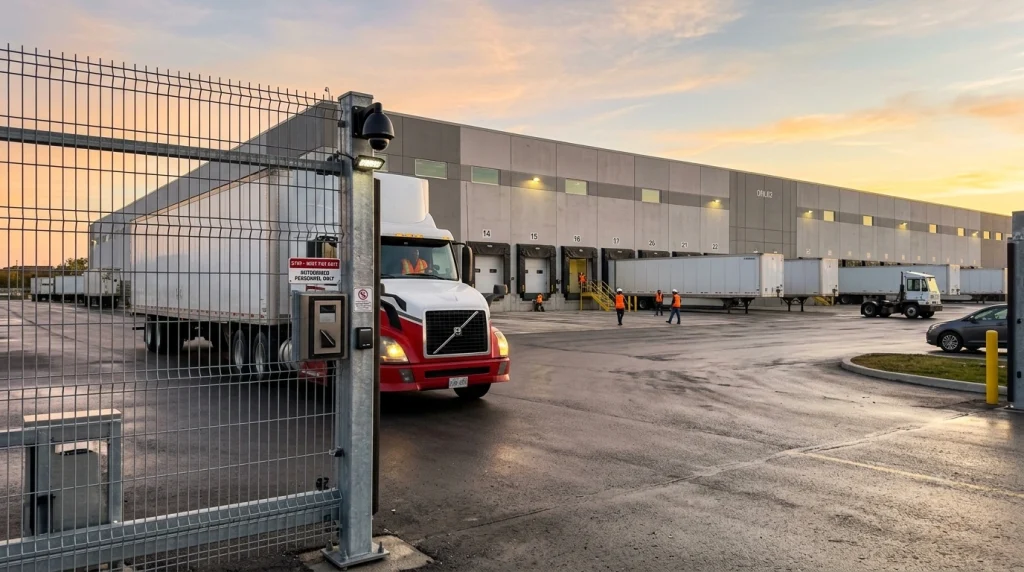
Perimeter Fencing for Warehouses and Distribution Centres: A Loss-Prevention Checklist
If you manage a warehouse or distribution centre anywhere in Canada, you already know the pressure is real. Cargo theft across the U.S. and Canada hit roughly $725 million in losses during 2025 alone, which was a staggering 60% jump from the year before. And the average value per theft? Over $270,000. Those are not just numbers on a page. That is entire shipments of electronics, metals, consumer goods, and raw materials walking out the door (or more accurately, being driven off the lot while nobody is watching).
Here in Ontario and across the Greater Toronto Area, the problem has gotten especially bad. Organized criminal groups have been targeting distribution hubs and logistics parks in the Peel Region with methods that are becoming more and more sophisticated. We are talking about staged distractions, fictitious carrier pickups, and late-night break-ins through fences that were never built to stop a determined intruder.
So where do you start if you want to actually protect your facility? The answer almost always begins at the property line. Your perimeter fence is the very first thing standing between a thief and your inventory. If it is weak, outdated, or poorly planned, everything behind it is vulnerable.
This checklist will walk you through the most important things to consider when evaluating (or upgrading) perimeter fencing for your warehouse or distribution centre. We have based it on real-world concerns that Canadian facility managers deal with every day, including the questions most people never think to ask until it is too late.
Start with the Basics: What Is Your Fence Actually Doing?
Before you shop for products or call a contractor, take a step back and think about what your perimeter fence needs to accomplish. Too many facility managers treat fencing as a checkbox item, something the insurance company asked for, so they put up the cheapest option and moved on. That approach leaves gaps, literally and figuratively.
A proper perimeter fence for a warehouse or distribution centre should accomplish at least four things. First, it needs to define a clear boundary so there is no ambiguity about where your property starts and public access ends. Second, it should physically deter and delay unauthorized entry. Third, it needs to funnel all vehicle and pedestrian traffic toward controlled access points. And fourth, it should support other security layers like cameras, lighting, and alarm sensors.
If your current fence is not doing all four of those things, it is time for a serious conversation about an upgrade.
The Fencing Material Question: Chain Link vs. Welded Wire vs. High-Security Panels
This is probably the most common question Canadian warehouse operators ask, and it deserves a thoughtful answer because there is no single right choice for every situation.
Chain Link Fencing
Chain link fencing remains the workhorse of commercial and industrial perimeters across Ontario. It is affordable, easy to install on varied terrain, and it holds up well against Canadian winters when you choose a galvanized or vinyl-coated finish. For many warehouses, a properly installed chain link system with barbed wire or razor ribbon on top provides a solid first line of defence. You can see Firm Fence's commercial chain link solutions here.

Welded Wire Fencing
That said, chain link does have limitations. An experienced thief with a decent pair of bolt cutters can get through standard chain link in under a minute. If your facility stores high-value goods (think electronics, pharmaceuticals, metals, or auto parts), you may want to consider welded wire fencing. Welded wire panels use a rigid, anti-climb mesh design that is significantly harder to cut and nearly impossible to climb. These panels also give your property a cleaner, more modern look, which matters if you are operating near public roads or in a business park. View Firm Fence's welded wire fencing options here.

High-Security & Crash-Rated Fencing
For the highest-risk environments, such as bonded warehouses, pharmaceutical storage, or facilities near airports and transit corridors, high-security and crash-rated fencing systems offer reinforced steel construction and anti-ram capability. These are engineered to stop vehicles, not just people, and they meet or exceed ASTM standards for forced-entry resistance. Explore Firm Fence's high-security and crash-rated fencing here.

Gates and Access Points: The Weakest Link in Most Perimeters
You can have the strongest fence in the world, but if your gate is flimsy, slow to close, or left open during shift changes, it is all for nothing. Gates are where most unauthorized entries actually happen at warehouse facilities. Loading docks, truck entrances, employee parking lots, and service roads all create openings in your perimeter that need to be managed with the same level of care as the fence itself.
Cantilever Gates
For distribution centres that handle a high volume of truck traffic, cantilever gates are an excellent choice. They float on rollers mounted to posts (no ground track), which means snow, ice, gravel, and debris will not jam them up the way traditional sliding gates can get stuck during a Canadian winter. If you have ever dealt with a frozen gate track in January, you know exactly why this matters. Learn more about cantilever gates here.

Automated Gate Systems
Pair your gates with an automated gate system and you add another layer of control. Modern automation setups integrate with RFID card readers, keypads, intercoms, and even camera systems so you have a complete record of who entered and when. For facilities that run 24/7 or have minimal overnight staffing, automation is not a luxury. It is a necessity. View automated gate systems here.

Barrier Arms (Traffic Barriers)
For parking areas, employee lots, and visitor check-in zones, barrier arms offer fast, efficient traffic control without requiring a full gate structure. They integrate easily with ticket dispensers, RFID readers, and security booths, and they are available in heavy-duty and crash-rated versions for higher-risk applications. See barrier arms and traffic barriers here.

Height, Topping, and Anti-Climb Features: How Tall Is Tall Enough?
This is another question that comes up constantly, and the answer depends on your municipality, your insurance requirements, and the threat level at your specific site. In Ontario, commercial and industrial properties generally have more flexibility on fence height than residential lots. While residential fences in Toronto are capped at 4 feet in front yards and 6 feet at the sides and rear, industrial and commercial zoning typically allows for taller fencing, often 8 feet or more, especially when justified by security needs.
As a general rule, any warehouse perimeter fence should be at least 6 feet tall, and 8 feet is better. If your property stores goods that are frequently targeted (metals, electronics, automotive parts), consider adding barbed wire, razor coil, or anti-climb brackets along the top. Some municipalities require a permit for barbed wire or razor wire, so check your local bylaws before installation. Your fencing contractor should be able to walk you through what is and is not permitted in your area.
One detail people tend to overlook: the bottom of the fence matters just as much as the top. If there is a gap between the bottom rail and the ground, someone can slide under it. On uneven terrain, custom fabrication may be needed to ensure the fence follows the contour of the land without leaving vulnerable gaps.
Lighting, Cameras, and the "Layered Security" Approach
A fence by itself will not stop every threat. But a fence combined with proper lighting, surveillance cameras, and alarm sensors creates what security professionals call a layered defence system. Each layer makes the others more effective.
Lighting is the easiest and cheapest upgrade most facilities can make. A well-lit perimeter eliminates the shadows that intruders rely on. Motion-activated floodlights along the fence line are particularly effective because they draw attention to movement without running up your electricity bill around the clock.
Cameras should be positioned to cover every gate, every loading dock, and every section of fence that is not directly visible from your main building. The key word here is "monitored." Research has consistently shown that cameras recording to a hard drive without anyone watching the feed do very little to prevent crime. Actively monitored systems, where a security team or remote monitoring service watches the feed in real time, are far more effective as a deterrent.
Questions Canadian Facility Managers Should Be Asking (But Usually Do Not)
There are a few topics that rarely get discussed in fencing conversations, even though they can make or break your loss-prevention strategy.
Does my fence meet my insurance provider's requirements?
Many commercial insurance policies in Canada include specific clauses about perimeter security. If your fence does not meet those requirements, you could face higher premiums or, worse, a denied claim after a theft. Ask your insurer for their exact specifications before you finalize any fencing project.
What happens to my fence in a freeze-thaw cycle?
Canadian winters are brutal on fencing infrastructure. Posts set in poorly prepared footings can heave out of the ground. Gate tracks fill with ice. Chain link mesh expands and contracts. Make sure your contractor understands the local frost line depth and uses proper concrete footings designed for your region's climate. In Ontario, frost depth typically sits between 4 and 5 feet, so posts need to be set deep enough to avoid shifting.
Who is responsible for the fence on a shared property line?
This comes up all the time in industrial parks and logistics corridors where multiple businesses share boundary lines. Ontario's Line Fences Act provides a framework for resolving disputes about boundary fences, but it is primarily geared toward rural and agricultural properties. In commercial settings, the answer usually comes down to what is in your lease or property agreement. Sort this out before you spend money on a fence that your neighbour might dispute.
Can I install a fence near a public sidewalk or road allowance?
In many Ontario municipalities, there are setback requirements that prevent you from building a fence right up to the edge of a road allowance or public right-of-way. Violating these rules can result in the city ordering you to remove or relocate your fence at your own expense. Always confirm setback distances with your local building department.
How often should perimeter fencing be inspected?
At minimum, you should be doing a full visual inspection of your perimeter fence at least once per quarter. After major storms, heavy snowfall, or any incident of attempted entry, do an immediate inspection. Look for bent or cut mesh, loose posts, damaged gate hardware, failed lighting, and signs of digging near the base of the fence. Document everything with photos and dates for your insurance records.
Do Not Forget Interior Fencing
While this blog focuses on perimeter security, it is worth mentioning that interior fencing plays an important role in loss prevention too. Inside your warehouse, caged enclosures around high-value storage areas, restricted zones with keypad or card-reader access, and secure dock areas all help to limit internal shrinkage. Some estimates suggest that internal theft accounts for a significant portion of warehouse losses, so protecting the inside of your building is just as important as securing the outside.
Choosing the Right Fencing Partner
Here is the truth that most people learn the hard way: the quality of your installation matters just as much as the quality of the product. A top-of-the-line fence panel installed with sloppy post work, shallow footings, or misaligned gates will fail sooner than a mid-range product installed correctly by an experienced crew.
When choosing a fencing contractor for a warehouse or distribution centre, look for a company that specializes in commercial and industrial work, not someone who mostly builds residential backyard fences. The requirements are completely different. Commercial projects demand heavier materials, deeper footings, larger gates, and integration with access control and security systems.
Firm Fence has been providing commercial and industrial fencing solutions across Ontario since 1979. With more than 45 years of experience, their team works with distribution centres, transit facilities, utility substations, and institutional properties. From initial site evaluation through installation and final inspection, they handle every phase of the project. You can learn more about their full range of solutions at https://www.firmfence.com/ or reach their team at 416-233-1811.
Loss prevention is not a single product or a one-time project. It is an ongoing strategy that starts at your property line and works inward. Your perimeter fence is the foundation of that strategy, and getting it right makes everything else, from cameras to access control to security patrols, more effective.
Protect Your Facility Starting at the Perimeter
If you are operating a warehouse or distribution centre in Ontario and your current fencing setup has not been evaluated in the last few years, now is the time. The threats are evolving, and your defences need to keep pace. Start with this checklist, ask the hard questions, and work with a contractor who understands what is at stake.
Your inventory, your business, and your peace of mind depend on it.
Explore Firm Fence Solutions