
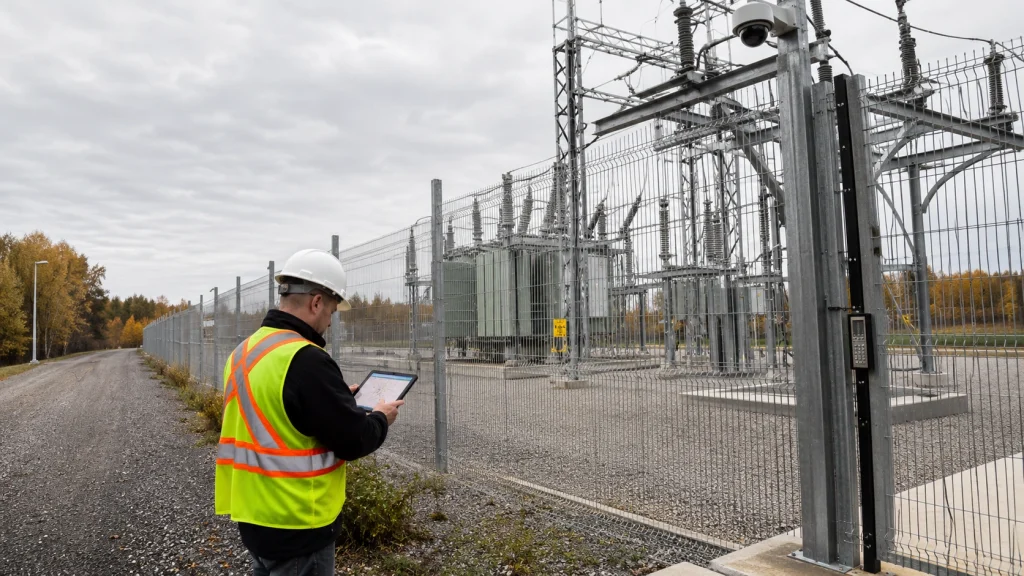
Fencing Utility Substations and Critical Infrastructure: What Every Canadian Facility Manager Needs to Know
If you manage or oversee a utility substation, a hospital campus, an LRT corridor, an airport perimeter, or any piece of critical infrastructure in Canada, here is something worth thinking about: the perimeter fence around your facility is not just a boundary marker. It is, in every practical sense, the first thing standing between your operations and a growing list of threats that have become impossible to ignore.
And yet, a surprising number of Canadian facilities are still relying on perimeter security that was installed decades ago, back when the threat landscape looked very different from what it does today.
Let us talk about why that is changing, what the regulations actually require, and what kinds of fencing systems are making a real difference on the ground in Ontario and across the country.
The Copper Theft Crisis No One Saw Coming
You have probably seen the headlines. Copper theft at Canadian electrical substations and telecom sites has exploded over the past two years. A Senate committee report from April 2026 described the situation as an urgent national crisis, with telecom and electricity companies reporting that these crimes are putting lives at risk by cutting communities off from emergency services.
The numbers are striking. In Ontario alone, seven people have died from copper theft-related electrocutions over the past decade. Maritime Electric on P.E.I. had to shut power off to 3,400 customers after thieves broke into the Bagnall Road substation and stole copper wiring. In London, Ontario, 23 incidents of copper wire theft were reported in just five months, with thieves targeting the underground hydro grid in the early morning hours.
And here is the part that should worry every facility manager: in a December 2024 Senate investigation, Alberta RCMP testified that many of the affected sites did not have basic prevention infrastructure in place. No fences. No cameras. No controlled entry. No security guards.
The federal government responded in July 2026 by implementing new sentencing provisions under the Bail and Sentencing Reform Act (Bill C-14), strengthening consequences for crimes that damage essential infrastructure. But tougher penalties only work after the fact. The question for facility managers is this: what are you doing to prevent a breach from happening in the first place?
What Do the Regulations Actually Require?
This is one of the most common questions we hear from facility managers and project engineers across Ontario, and the answer depends on what kind of infrastructure you are protecting.
For electrical utilities and substations, the NERC CIP standards (North American Electric Reliability Corporation, Critical Infrastructure Protection) set the baseline. These are not suggestions or best practices. They carry the force of law and apply to all bulk electric system owners and operators in Canada and the United States. The CIP-014 standard, specifically, requires transmission owners to perform risk assessments of their substations and develop physical security plans for any sites where damage or disruption could cause instability or cascading failures across the grid.
For airports, the requirements come from Transport Canada and align with international standards. For hospitals, provincial building and fire codes dictate minimum perimeter requirements. LRT systems and transit corridors have their own set of security mandates, often driven by municipal governments and transit authorities.
The common thread across all of these? A layered security approach that starts at the perimeter. And in every case, the fence is where that perimeter begins.
Why Old Chain Link is Not Enough Anymore
Let us be honest about something. Twenty years ago, a six-foot chain link fence with barbed wire on top was considered adequate security for just about any industrial or utility site in Canada. For many lower-risk applications, chain link is still a perfectly reasonable, cost-effective solution. It is durable, low-maintenance, and works well on varied terrain. If your primary goal is boundary marking, general access control, and keeping casual trespassers out, chain link does the job.

Chain Link Fencing
Firm Fence offers a full range of Chain Link Fencing solutions built with galvanized or vinyl-coated finishes, with options for barbed wire, privacy slats, and tension wire to match different site requirements. Learn more about Chain Link Fencing
But for critical infrastructure, the threat has moved well beyond casual trespassing. Organized copper theft rings are using bolt cutters to get through standard chain link in under a minute. Coordinated attacks on electrical substations have been documented across North America. And the liability exposure for a facility manager whose perimeter gets breached at a live substation is enormous, both in terms of human safety and financial consequences.
That is why so many Canadian utilities and infrastructure operators are upgrading their perimeters to more advanced systems.
Welded Wire Fencing: The Anti-Climb Standard
For substations, data centres, airports, and high-security commercial sites, welded wire fencing has become the go-to solution. Unlike traditional chain link, welded wire panels feature a rigid, anti-climb mesh pattern that makes it extremely difficult for intruders to get footholds or handholds. The tight mesh also resists cutting far better than standard woven wire.
What makes welded wire particularly well-suited for utility substations is the fact that it maintains full visibility through the fence line. This matters because security cameras, patrol vehicles, and monitoring personnel need clear sightlines to do their jobs effectively. A fence that blocks the view of the interior can actually make a site less secure, not more.

Welded Wire Fencing
Firm Fence installs Welded Wire Fencing systems designed for exactly these kinds of demanding environments, with rigid panel construction, high cut-resistance, and a clean, modern appearance that does not compromise on security. Learn more about Welded Wire Fencing
When You Need Maximum Protection: High-Security and Crash-Rated Systems
Some sites face threats that go beyond someone with a pair of bolt cutters. Airports, government buildings, power stations, military installations, and certain high-risk utility sites need perimeter systems that can stop a vehicle, resist forced entry, and hold up under sustained physical attack.
This is where high-security and crash-rated fencing comes in. These systems are built with reinforced steel posts and welded panels, engineered to withstand vehicle impact and forced entry attempts. They meet or exceed ASTM and government testing standards and can be integrated with electronic access control for a fully connected security perimeter.

High-Security & Crash-Rated Fencing
Firm Fence provides High-Security and Crash-Rated Fencing solutions for sites that require the highest level of perimeter protection, including airports, correctional facilities, and critical utility infrastructure. Learn more about High-Security & Crash-Rated Fencing
Controlling Access Points: Gates and Automation
A fence is only as strong as its weakest point, and that weakest point is almost always the gate. If you have a world-class perimeter fence but your gate can be forced open with a truck or bypassed by someone who knows the code, you have a serious vulnerability.
For critical infrastructure sites, automated gate systems are essential. They allow controlled access via remote operation, keypad, or RFID credentials, and they can be integrated with cameras, intercoms, and smart controllers to create a complete access management system. Heavy-duty motors ensure reliable operation even in high-cycle environments where dozens or hundreds of authorized entries happen every day.

Automated Gate Systems
Firm Fence specializes in Automated Gate Systems that combine functionality, safety, and convenience across swing, sliding, and cantilever gate types. Learn more about Automated Gate Systems
For sites where a ground track is not practical (think Canadian winters, where snow and ice can jam a traditional sliding gate rail), cantilever gates are often the better choice. They operate without a ground track, making them ideal for harsh weather conditions and uneven terrain.

And for the highest-risk access points at airports, government facilities, and critical infrastructure sites, crash-rated barriers provide certified protection against forced vehicle entry. These systems, available as bollards, wedge barriers, or beam gates, meet stringent K4 to K12 and M30 to M50 impact ratings.

Questions Canadian Facility Managers Keep Asking
Having worked with industrial, commercial, and institutional clients across Ontario for over 45 years, there are a handful of questions that come up again and again. Here are the ones that deserve straight answers.
"Do I really need to upgrade my existing fence, or am I fine with what I have?"
It depends on your risk profile. If your site has experienced any incidents of trespassing, theft, or vandalism, or if you are subject to NERC CIP, Transport Canada, or provincial security mandates, a professional assessment is worth doing. The cost of upgrading a perimeter is almost always a fraction of the cost of a single serious security incident.
"How do I know what height and type of fence my substation actually requires?"
There is no universal answer, because the right specification depends on factors like the voltage levels at your site, the surrounding environment, local bylaws, and your specific regulatory obligations. A qualified fencing contractor with experience in critical infrastructure can walk your site and recommend the right combination of fence type, height, toppings, and access control.
"Can fencing really hold up to a Canadian winter?"
This is a legitimate concern, and one that comes up constantly. The answer is yes, but only if the system is designed for it. Galvanized and powder-coated finishes protect against corrosion from road salt and freeze-thaw cycles. Cantilever gates eliminate ground-track ice problems. And properly engineered post foundations account for frost heave, which is a real issue across most of Ontario and the rest of the country.
"What about integrating cameras and alarms with my fence?"
Modern perimeter security is not just about the physical barrier. The fence should serve as a platform for a broader security ecosystem that includes surveillance cameras, intrusion detection sensors, alarm systems, and access control. Many of the fencing and gate systems installed today are designed from the ground up to support these integrations.
The Bottom Line
The security landscape around Canadian critical infrastructure has changed dramatically in just the past few years. Copper theft alone has gone from a nuisance to a national crisis. Regulatory requirements are getting stricter. And the consequences of a perimeter breach at a substation, an airport, or a hospital campus can be measured in human lives, not just dollars.
If your facility's perimeter has not been assessed recently, now is the time. And if you are planning a new build or a major upgrade, the decisions you make about your fencing and access control systems will shape your security posture for the next 20 years.
Why Firm Fence
Firm Fence has been securing commercial and industrial properties across Ontario since 1979. From utility substations and transit corridors to hospitals and airport perimeters, we bring the experience and the product range to design, install, and maintain perimeter security systems that actually work.
Ready to talk about your site?
Contact Firm Fence for a free estimate. Phone: 416-233-1811 · Email: kris@firmfence.com · Location: 61 Unit B Baywood Rd, Etobicoke, ON M9V 3Y8
Get a Free Estimate